
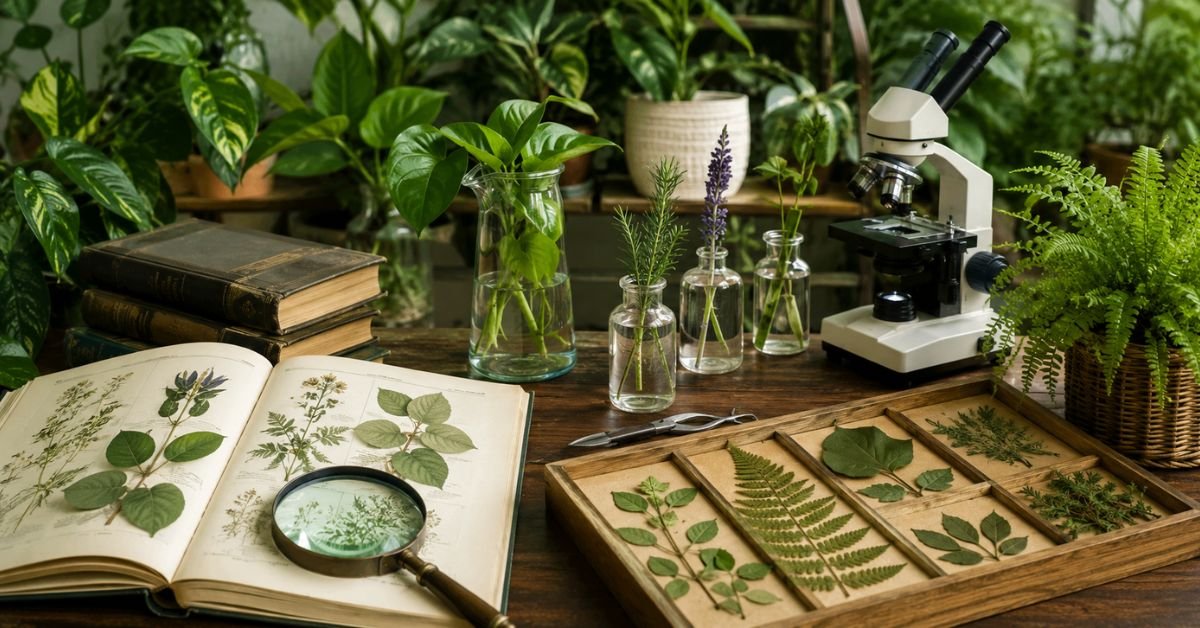
Classifying plants means grouping plants according to shared characteristics, biological relationships, and evolutionary history. Scientists examine features such as vascular tissue, seeds, spores, flowers, leaves, reproductive structures, and genetic evidence to determine how plants should be grouped and named.
At first, plant classification can sound like a long list of terms to memorize. Kingdom, family, genus, species, angiosperm, gymnosperm, monocot, eudicot. But the basic idea is much simpler.
We classify plants so we can organize their enormous diversity, identify them accurately, understand how they are related, and communicate about them without relying on confusing common names.
Plant Classification at a Glance
| Plant group | Main characteristic | Familiar examples |
| Nonvascular plants | Lack specialized vascular tissues | Mosses, liverworts, hornworts |
| Seedless vascular plants | Have vascular tissues but reproduce with spores | Ferns |
| Gymnosperms | Produce seeds that are not enclosed in fruits | Pines, spruces, cycads |
| Angiosperms | Flowering plants with seeds enclosed in fruits | Sunflowers, tomatoes, roses |
| Monocots | Major angiosperm group with one cotyledon | Corn, grasses, lilies |
| Eudicots | Major angiosperm group with two cotyledons and other defining traits | Beans, sunflowers, roses |
This is a simplified learning framework, not the complete modern taxonomic system. Real plant relationships are more detailed, and classifications can change as scientists gain better evidence.
Personal Pro-Tip: Learn the major plant groups before trying to memorize taxonomic ranks. The overall structure makes the individual terms much easier to remember.
What Does Classifying Plants Mean?

Classifying plants is the process of arranging plants into groups based on characteristics they share and, increasingly, their evolutionary relationships.
This work is closely tied to plant taxonomy, the scientific study of identifying, naming, describing, and classifying plants. Taxonomy gives us a standard way to organize plants from broad categories down to individual species.
Think of it as a filing system.
A broad group contains smaller groups. Those smaller groups contain even more specific groups. By the time you reach genus and species, you have narrowed the classification to a much more precise level.
This system is especially useful because common plant names are unreliable. A single common name can refer to different plants in different regions, while one plant may have several common names.
Scientific names solve much of that confusion.
The two-part scientific naming system uses a genus followed by a specific epithet. Together, they identify a species.
For gardeners, that precision matters. When you know the scientific name of a plant, it becomes much easier to find trustworthy information about its characteristics, growing requirements, pests, diseases, and hardiness.
Personal Pro-Tip: When a plant name seems confusing, find the scientific name before searching for information. It is usually the fastest way to separate one plant from another.
Why Do Scientists Classify Plants?
Plant classification is not just an academic exercise.
Scientists classify plants because the plant kingdom contains an enormous amount of diversity. Without an organizing system, studying and communicating about that diversity would be far more difficult.
Classification helps scientists:
- organize biodiversity
- identify unknown plants
- describe relationships among plants
- communicate consistently
- study evolution
- organize biological information
- develop identification tools
It also helps people outside science.
A gardener researching a plant, a nursery labeling stock, a university teaching botany, and a researcher studying plant diseases all benefit from knowing exactly which plant they are discussing.
The value of classification becomes especially obvious when common names create confusion. A scientific name gives everyone a much more precise reference point.
Personal Pro-Tip: Think of classification as the foundation that connects plant identification, botany, horticulture, and scientific research.
How Do Scientists Classify Plants?
There is no single feature that explains the entire plant kingdom.
Scientists use different types of evidence, and the importance of each feature depends on the plants being studied and the level of classification involved.
Plant Classification by Structure
Plant structure, also called morphology, is one of the oldest and most useful sources of evidence.
Scientists can examine:
- roots
- stems
- leaves
- leaf arrangement
- flowers
- fruits
- seeds
- reproductive structures
These features can reveal important differences between plants.
A fern, for example, has a very different structure and reproductive strategy from a pine tree. A grass has a different overall morphology from a rose.
Still, appearance alone is not always enough.
Different plants can evolve similar features because they live in similar environments. Two plants may look alike without being closely related.
That is one reason modern plant classification uses multiple kinds of evidence instead of relying only on appearance.
Personal Pro-Tip: When identifying a plant, look at several characteristics together. One leaf shape or one flower feature rarely tells the whole story.
Plant Classification by Spores and Seeds
Reproduction provides another major clue.
A simplified classification framework separates plants according to whether they reproduce using spores or seeds.
Mosses and ferns are familiar examples of plants associated with spores.
Gymnosperms and angiosperms produce seeds, but they differ in how those seeds are associated with reproductive structures.
This distinction is one of the easiest ways to understand the broad differences between major plant groups.
It also shows why several common assumptions are wrong. Not every plant with roots, stems, and leaves produces seeds, and not every seed-producing plant is a flowering plant.
Personal Pro-Tip: When studying plant classification, ask, “How does this plant reproduce?” It is often one of the quickest ways to narrow down the possibilities.
Plant Classification and Evolutionary Evidence
Modern plant classification is not based only on what plants look like.
Scientists increasingly use evidence about evolutionary relationships, including molecular and genetic information, to determine how groups are related.
This matters because similar appearance does not always indicate close ancestry.
Modern classification tries to produce groups that better reflect the evolutionary history of plants rather than simply grouping organisms that happen to look alike.
That is also why taxonomic systems can change.
A plant does not suddenly become a different organism because its classification was revised. The scientific interpretation of its relationship to other organisms has changed.
Personal Pro-Tip: When an older gardening book and a newer scientific source use different names, check whether the plant’s accepted classification has been updated rather than assuming one source must be wrong.
The Major Groups in Plant Classification
The easiest way to understand classifying plants is to work from broad groups toward narrower ones.
Nonvascular Plants
Nonvascular plants include mosses, liverworts, and hornworts.
They do not have the specialized vascular tissues found in vascular plants. They are generally associated with environments where moisture is readily available because their structure does not provide the same transport system found in vascular plants.
Their small size is not the definition of the group. The absence of specialized vascular tissue is the important distinction.
Personal Pro-Tip: Do not classify a plant as nonvascular just because it is small. Size can be misleading.
Seedless Vascular Plants
Seedless vascular plants have vascular tissues but reproduce with spores instead of seeds.
Ferns are the best-known examples.
This group is important because it demonstrates that vascular plants are not automatically seed-producing plants.
Ferns can have roots, stems, and leaves and still reproduce without flowers or seeds.
Personal Pro-Tip: A simple memory trick is “fern equals vascular, but not seed-producing.”
Gymnosperms
Gymnosperms are vascular seed plants whose seeds are not enclosed within fruits in the way they are in flowering plants.
Pines, spruces, firs, cycads, and ginkgo are familiar examples.
Many gymnosperms are associated with cones, especially conifers. The word gymnosperm is traditionally associated with the idea of a “naked seed.”
Gymnosperms are therefore different from angiosperms, even though both groups produce seeds.
Personal Pro-Tip: Use pine trees as your mental example of a gymnosperm, but remember that gymnosperms are broader than conifers alone.
Angiosperms
Angiosperms are flowering plants.
This is the group that includes much of the plant diversity you see in American gardens, farms, forests, lawns, and landscapes.
Sunflowers, tomatoes, beans, roses, oaks, and grasses are all angiosperms.
Their defining reproductive system is based around flowers, with seeds developing within structures associated with fruits.
Personal Pro-Tip: If you are looking at a typical flowering garden plant, angiosperm is usually the correct broad group. The next question is which smaller group it belongs to.
Monocots and Eudicots in Plant Classification
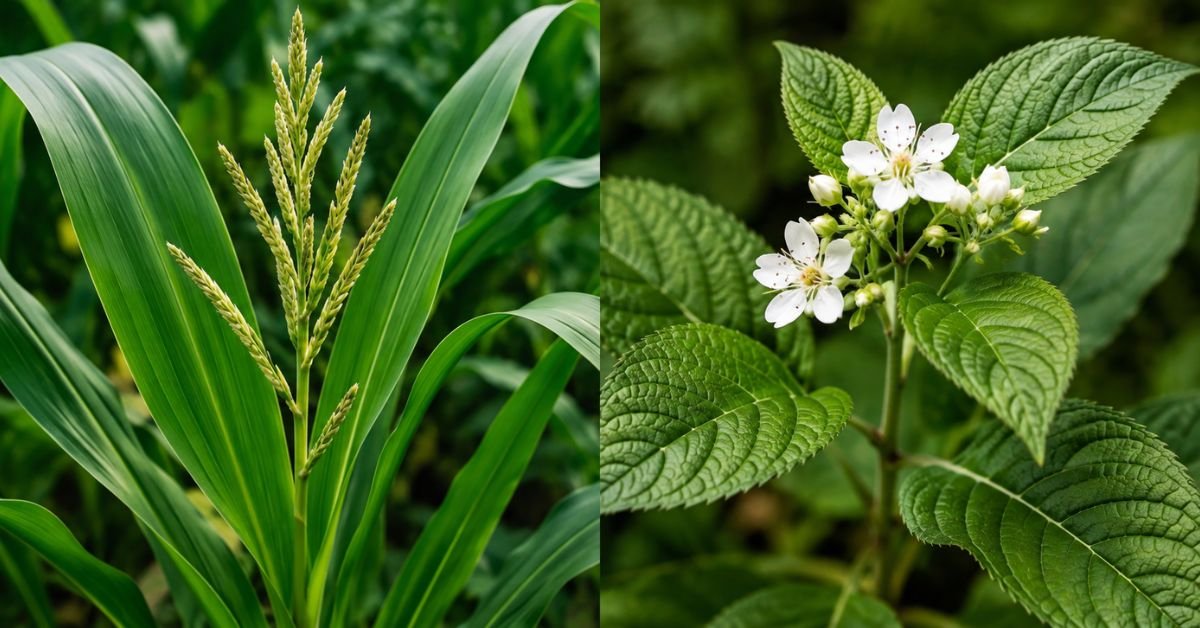
When people learn about flowering plants, they often encounter the terms monocots and dicots.
There is an important scientific detail here.
“Dicot” is a traditional teaching term, while eudicots represent a major evolutionary group recognized in modern angiosperm classification.
So the familiar monocot versus dicot comparison is useful, but it should not be treated as the complete modern classification of flowering plants.
Monocot Classification
Monocots generally have one cotyledon, or seed leaf, in the embryo.
Many monocots also share other characteristic features involving leaves, roots, vascular arrangement, and flowers.
Familiar examples include:
- corn
- grasses
- lilies
- orchids
- palms
These plants can look very different from one another, which shows that classification depends on a collection of traits rather than a single visual feature.
Personal Pro-Tip: Corn and grass are easy examples to remember when studying monocots.
Eudicot Classification
Eudicots make up a huge portion of familiar flowering plants.
Beans, roses, tomatoes, and sunflowers are common examples.
They are not simply “plants with two leaves.” Eudicots are a major evolutionary group within the angiosperms, defined by a collection of characteristics and evolutionary relationships.
That distinction is important because it prevents the common beginner mistake of treating “two cotyledons” as the entire definition.
Personal Pro-Tip: Learn the term eudicot now, even if you still see “dicot” in older textbooks and gardening references.
The Plant Taxonomy Hierarchy
Once you understand the major groups, taxonomy becomes easier to visualize.
A commonly taught hierarchy is:
Domain → Kingdom → Division or Phylum → Class → Order → Family → Genus → Species
The exact ranks shown can vary by taxonomic system, and additional ranks can be added between them.
The key idea is simple:
Broad classification becomes increasingly specific as you move downward.
Kingdom
The kingdom is a very broad category.
Most basic plant classification lessons place plants within Kingdom Plantae, although modern biology uses more detailed systems at higher taxonomic levels.
Division or Phylum
Plants are further divided into major groups based on important biological characteristics and relationships.
Class, Order, and Family
Each of these levels narrows the group further.
A plant family can contain many genera, while an individual genus can contain multiple species.
Genus
A genus contains closely related species.
The genus is the first part of a scientific plant name.
Species
Species is a much more specific classification level.
The scientific name of a species combines the genus with the specific epithet.
That is why scientific names are so useful. They tell you exactly which plant you are discussing instead of leaving you to guess from a common name.
Personal Pro-Tip: Memorize the hierarchy as a narrowing system rather than as isolated vocabulary. The logic matters more than reciting the list.
A Simple Example of Plant Classification
Let’s use a familiar flowering plant to see how the hierarchy works.
Take a common sunflower, Helianthus annuus.
You can describe it at several levels:
Kingdom: Plantae
Broad group: Angiosperms
Major flowering-plant group: Eudicots
Family: Asteraceae
Genus: Helianthus
Species: Helianthus annuus
The exact classification can be expanded much further, but the point is to see how the levels fit together.
At the broad level, the sunflower is a flowering plant.
At a more specific level, it belongs to a particular family.
At the narrowest level, the scientific name identifies the species.
That is the basic logic behind taxonomic classification.
Personal Pro-Tip: Choose one plant you already know and practice moving from kingdom toward species. It is much easier to remember taxonomy when you attach it to a real plant.
Classifying Plants vs. Identifying Plants
These terms are related, but they are not interchangeable.
Identification asks: “What plant is this?”
Classification asks: “Where does this plant belong in the larger system?”
Suppose you find an unfamiliar plant growing in your yard.
You first examine its characteristics and determine that it is a particular species.
That is identification.
Then you place that species within its genus, family, order, and broader groups.
That is classification.
Identification and classification work together, but they answer different questions.
This distinction matters when using field guides and plant identification tools. A tool that gives you a species name is primarily helping you with identification. Taxonomy explains the larger placement of that species.
Personal Pro-Tip: Keep this simple: identification tells you what it is, while classification tells you where it belongs.
How to Classify an Unknown Plant
You do not need to memorize an entire botany textbook to begin.
A logical process is more useful than random guessing.
1. Observe the Whole Plant
Look at the overall growth form.
Is it a moss-like plant, fern, grass, herb, shrub, vine, or tree?
This will not identify the plant by itself, but it gives you a useful starting point.
2. Examine the Leaves
Notice the:
- shape
- arrangement
- margins
- veins
- texture
- attachment to the stem
3. Look for Flowers, Cones, Fruits, or Seeds
Reproductive features can be extremely valuable.
A flower can immediately place a plant among the angiosperms. A cone can point you toward a gymnosperm. Spores can provide clues about seedless groups.
4. Examine Stems and Roots
These characteristics can help distinguish broader plant groups.
5. Consider Where It Grows
Habitat is useful supporting evidence.
A plant growing in a wet forest environment presents a different set of possibilities from one found in a dry desert region.
Habitat should narrow the possibilities, not determine the answer by itself.
6. Use a Dichotomous Key
A dichotomous key gives you a sequence of choices based on observable traits.
Each choice narrows the possibilities until you reach a likely identification.
This is one of the most practical ways to turn plant observation into a repeatable identification process.
7. Confirm the Result
For important identifications, compare your findings with university extension resources, botanical gardens, herbaria, field guides, or recognized taxonomic databases.
Do not rely on one photograph or one app result when accuracy matters.
Personal Pro-Tip: The more important the identification, the more evidence you should require before accepting the answer.
Common Mistakes When Classifying Plants

Mistake 1: Treating Common Names as Scientific Names
Common names vary by region and can refer to different plants.
Always verify the scientific name when precision matters.
Mistake 2: Assuming Similar Appearance Means Close Relationship
Plants can evolve similar forms even when they are not closely related.
Appearance is evidence, but it is not the whole classification system.
Mistake 3: Assuming Vascular Means Seed-Producing
Ferns prove this wrong.
They are vascular plants that reproduce with spores.
Mistake 4: Treating Monocots and Dicots as the Entire Modern System
The traditional comparison is useful for learning, but modern angiosperm classification is more detailed and recognizes eudicots as a major evolutionary group.
Personal Pro-Tip: Most classification mistakes happen when a simple educational rule is treated as an absolute rule. Use simple frameworks to learn, then refine your understanding as you go deeper.
Why Plant Classification Changes
One thing that surprises beginners is that plant classification is not permanent.
Scientists revise classifications as new evidence becomes available.
Older systems relied more heavily on observable features. Modern plant systematics can combine morphology with molecular, genetic, and evolutionary evidence.
As a result, a plant can be moved to another genus, given a different accepted name, or placed in a revised group.
The plant itself did not change.
Our understanding of its relationships changed.
This is why you may sometimes find a newer botanical source using a different name from an older gardening book.
A current scientific source may be reflecting a more recent taxonomic treatment.
This is also why it is useful to check authoritative resources such as university extension programs, botanical institutions, USDA plant information resources, and established taxonomic databases when names conflict.
Personal Pro-Tip: When two sources disagree, check the publication date and source authority before deciding which classification to trust.
Frequently Asked Questions About Classifying Plants
Q1. What does classifying plants mean?
Classifying plants means grouping plants according to shared characteristics and biological relationships. Scientists use structural, reproductive, morphological, and evolutionary evidence to organize those groups.
Q2. What are the major groups of plants?
A common introductory framework includes nonvascular plants, seedless vascular plants, gymnosperms, and angiosperms. Flowering plants can then be discussed using major groups such as monocots and eudicots.
Q3. How do scientists classify plants?
Scientists can examine plant structure, vascular tissue, reproductive features, seeds, flowers, fruits, morphology, and evolutionary or genetic evidence. Modern classification uses multiple types of evidence rather than relying only on appearance.
Q4. What is plant taxonomy?
Plant taxonomy is the scientific study of identifying, naming, describing, and classifying plants. It organizes plants into a hierarchy that includes ranks such as family, genus, and species.
Q5. What is the difference between classification and identification?
Identification determines what a plant is, while classification determines where that plant belongs within a larger biological system. The two processes are closely connected but are not the same.
Q6. Are monocots and dicots still used?
Yes, especially in introductory education. However, modern flowering-plant classification is more precise, and eudicots are recognized as a major evolutionary group rather than treating all traditional “dicots” as one simple category.
Q7. Why does plant classification change?
Plant classification can change when scientists gain new evidence about evolutionary relationships. New molecular and genetic evidence can lead researchers to revise older classifications and scientific names.
Final Thoughts on Classifying Plants
Classifying plants is the system we use to make plant diversity understandable.
Instead of seeing every plant as a completely separate organism, classification helps us recognize patterns and relationships.
You can start with a few broad questions:
Does the plant have vascular tissue?
Does it reproduce with spores or seeds?
If it produces seeds, is it a gymnosperm or angiosperm?
If it is an angiosperm, does it belong to a major group such as a monocot or eudicot?
From there, the taxonomic hierarchy takes you toward family, genus, and species.
The biggest lesson is that plant classification is more than appearance. Scientists combine observable characteristics with evidence about biological and evolutionary relationships. That is why classification systems can become more precise over time.
For gardeners, this knowledge is practical too. Correct identification and classification make it easier to find reliable information about a plant, understand its relatives, and avoid confusion caused by common names.
You do not need to memorize the entire plant kingdom.
Start with the major groups, understand the logic behind the classification system, and then build your knowledge plant by plant.
Have you ever come across two different names for the same plant? Share the plant and the names you found in the comments.

Amin Khalid is a professional horticulturist and the founder of LeafyWisdom. With a deep passion for home gardening and horticultural research, he specializes in providing practical, easy-to-follow care guides for indoor plants. Amin’s goal is to simplify gardening for everyone and help fellow plant lovers build their own thriving green spaces.


No responses yet