
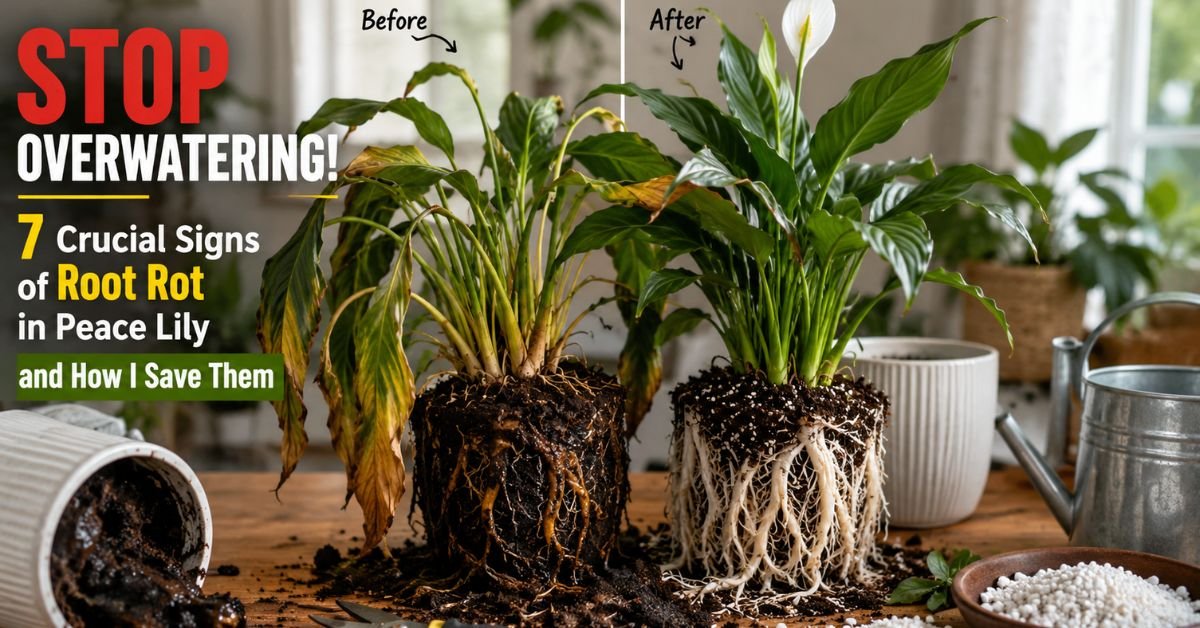
Signs of root rot in peace lily plants often appear when you least expect them. As a professional horticulturist, I see these symptoms frequently in indoor gardens. Specifically, you must identify these red flags early to save your plant. Understanding these signals will help you revive your greenery and prevent permanent damage.
Quick Care Guide for US Peace Lily Owners
| Care Factor | Ideal Requirement | US Home Tip |
| Light | Bright, indirect light | Keep away from drafty AC vents in Summer. |
| Water | Distilled or filtered water | Use lukewarm water straight from the faucet (if filtered). |
| Soil | Well-draining potting soil | Mix in some perlite to prevent “wet feet.” |
| Temp | $65^{\circ}F – 85^{\circ}F$ | Protect from chilly window drafts in Winter. |
| USDA Zones | Zones 11–12 | Best kept as an indoor perennial in most of the US. |
The Sneaky Signs of Root Rot in Peace Lily You Might Miss
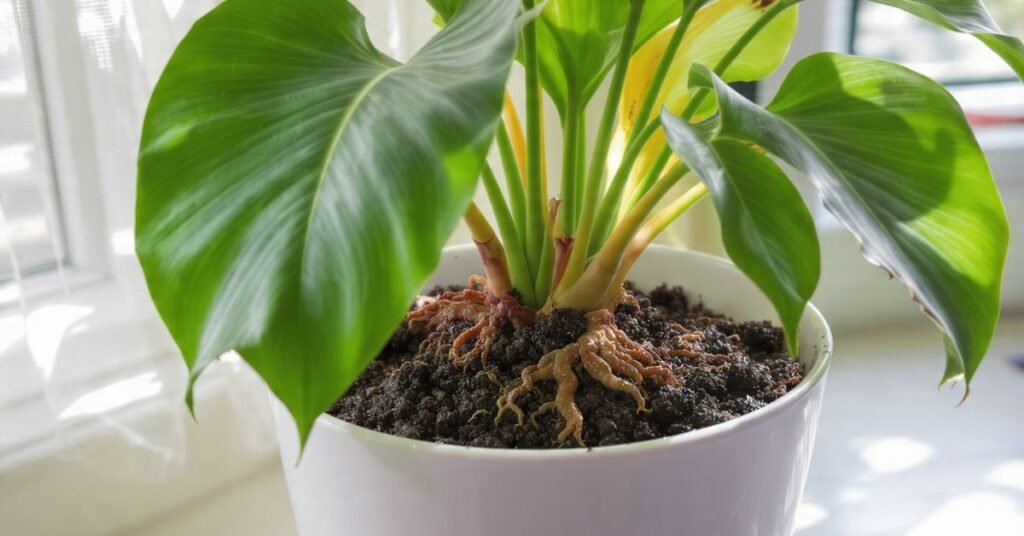
In my experience, the hardest part for most gardeners is realizing that a wilting plant doesn’t always need more water. If you’ve been topping off the pot every few days and the leaves are still drooping, your roots are likely suffocating.
One of the first signs of root rot in peace lily is yellowing leaves that start at the bottom of the plant. Unlike the crisp brown edges you see from low humidity (common in dry, air-conditioned American homes), root rot leaves feel soft, limp, and eventually turn a sickly translucent yellow.
Personal Pro-Tip: I always perform the “Sniff Test.” If you put your nose near the potting soil and it smells like a swamp or rotting vegetables instead of fresh earth, you’ve got a fungal issue below the surface.
Mushy Stems: A Major Sign of Root Rot in Peace Lily
If you reach down to the base of your plant and the stems feel squishy or come off in your hand with a gentle tug, the rot has moved from the roots into the crown. This is a critical stage. When we see these signs of root rot in a peace lily, time is of the essence. Healthy roots should be firm and white; rotted roots are black, slimy, and fall apart when touched.
Personal Pro-Tip: If you’re unsure, gently lift the plant out of its nursery pot. If the soil at the bottom is a muddy mess and the roots look like dark noodles, it’s time for emergency surgery.
Why Do Americans Often Fail with Peace Lilies?
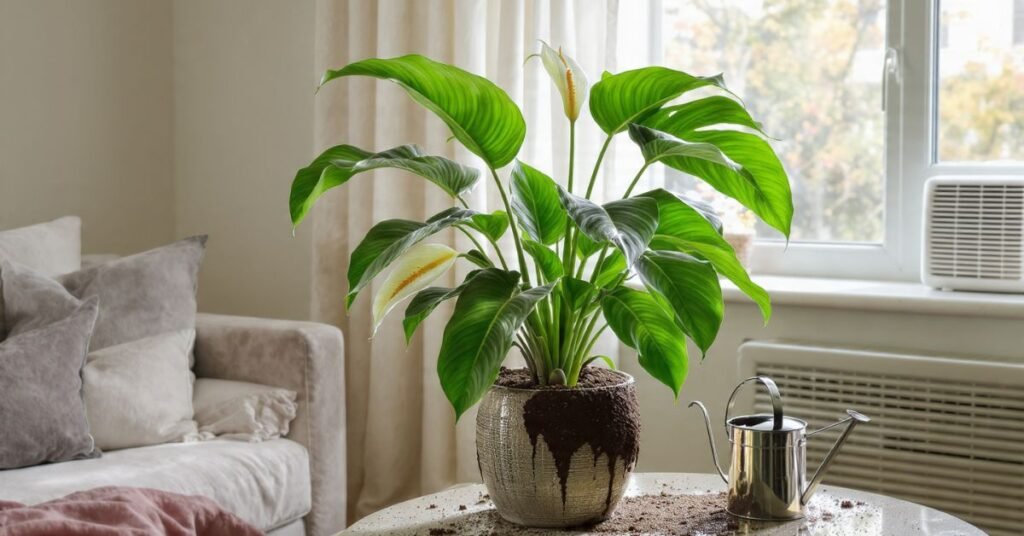
I see the same three mistakes popping up in homes from New York to California:
- The “AC Effect”: We love our air conditioning, but the dry air can trick you into thinking the plant is dry because the top inch of soil feels “crusty.” Meanwhile, the bottom of the pot is a lake.
- Using the Wrong “Dirt”: Many beginners use heavy outdoor garden soil or “compost” meant for raised beds. In a container, you must use a dedicated potting soil to allow for aeration.
- The “Calendar Watering” Trap: Watering every Monday regardless of the weather is a recipe for disaster. In the Fall and Winter, Peace Lilies grow slower and need significantly less water than in the Spring.
My Step-by-Step Fix for Signs of Root Rot in Peace Lily
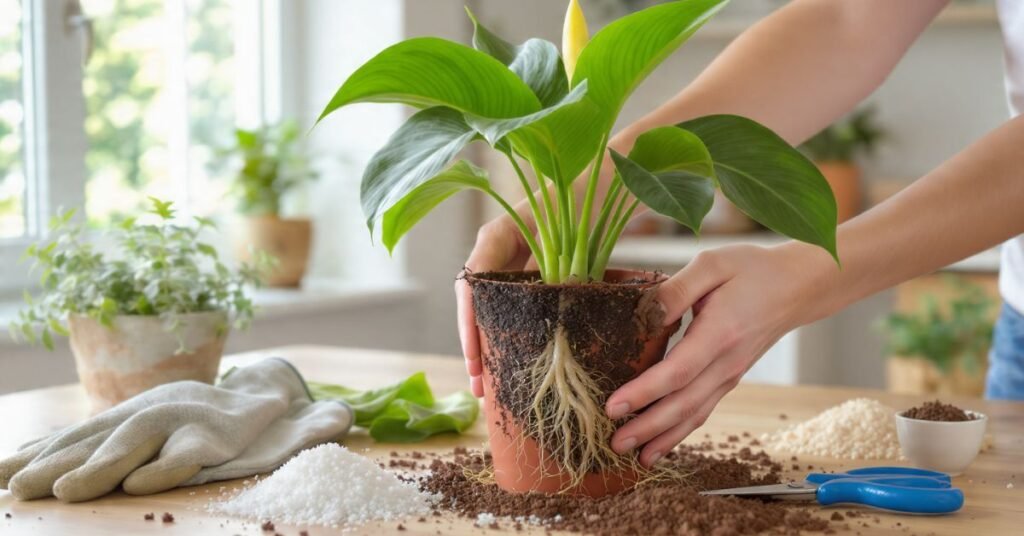
If you’ve spotted the signs of root rot in peace lily, don’t panic. Here is my “recovery room” protocol:
- Remove and Rinse: Take the plant out of the pot and wash all the old, infected potting soil off the roots under a faucet.
- Prune the Rot: Use sterilized scissors to snip off any black or mushy roots.
- Disinfect: I like to dip the remaining healthy roots in a mixture of one part 3% hydrogen peroxide to two parts water to kill lingering fungus.
- Repot Fresh: Use a new pot (or bleach the old one) and fresh, chunky potting soil.
Personal Pro-Tip: After repotting a recovering plant, I hold off on fertilizer for at least a month. The plant needs to focus on growing new “toes” (roots) before it tries to grow new “fingers” (leaves).
Troubleshooting Other Common Issues
- Brown Leaf Tips: Usually caused by the chlorine or fluoride in US municipal tap water. Try using filtered water or letting your water sit out overnight.
- No Flowers: Your plant likely isn’t getting enough light. Move it closer to an East-facing window.
- Dusty Leaves: Large leaves are magnets for dust in US homes. Wipe them down with a damp cloth so the plant can “breathe.”
Toxicity Warning: Keep Your Furry Friends Safe
In the US, we love our pets, and it’s vital to know that the Peace Lily is toxic to both cats and dogs. It contains calcium oxalate crystals. If chewed, it can cause intense oral irritation, drooling, and vomiting. If you have a curious tabby, keep this plant on a high shelf or a hanging planter.
Frequently Asked Questions
Q1. Can a peace lily recover from root rot?
Yes, but only if you catch it while there are still some firm, white roots left. If the entire root ball is mush, it’s usually better to take a healthy leaf cutting (if possible) or start over.
Q2. How often should I water to avoid signs of root rot in peace lily?
Don’t follow a schedule. Stick your finger two inches into the soil; if it feels dry, water it. If it’s damp, wait two more days.
Q3. Does the pot type matter?
Absolutely. I always recommend terra cotta for “heavy-handed” waterers because it’s porous and helps the soil dry out faster. If you use plastic or ceramic, ensure there are plenty of drainage holes.
Q4. Why is my peace lily still drooping after I watered it?
This is the classic “false thirst” sign. If the soil is wet but the plant is wilting, the roots are too damaged to “drink” the water. This is one of the most common signs of root rot in peace lily.
Q5. Should I use a moisture meter?
They can be helpful, but they aren’t always 100% accurate. Your finger is usually the best tool you have!
Q6. Can I use “tap water” from my faucet?
Most Peace Lilies are sensitive to the chemicals in US city water. If you see brown tips, switch to rainwater or distilled water.
Q7. Does AC affect root rot?
Indirectly, yes. AC vents can dry out the leaves, making you think the plant needs water when the roots are actually still wet.
Final Thoughts on Peace Lily Care
Caring for these plants is a learning curve. I’ve personally “drowned” a few plants in my early days before I learned to read the signs of root rot in peace lily. The key is to stop, look at the leaves, and feel the soil before you reach for the watering can.
If you give them the right drainage and keep them away from those chilly AC drafts, your Peace Lily will reward you with those iconic white blooms for years to come. Just remember: when in doubt, let it dry out!

Amin Khalid is a professional horticulturist and the founder of LeafyWisdom. With a deep passion for home gardening and horticultural research, he specializes in providing practical, easy-to-follow care guides for indoor plants. Amin’s goal is to simplify gardening for everyone and help fellow plant lovers build their own thriving green spaces.

No responses yet