
The best time to plant grass seed depends on the type of grass, where you live, and the conditions in your yard. For most cool-season grasses, late summer to early fall is the strongest general planting window. Warm season grasses usually do better when planted in late spring or early summer. The calendar is helpful, but it should not make the decision by itself. Soil temperature, moisture, sunlight, upcoming weather, and the amount of favorable growing time ahead can all change the answer.
When I think through a lawn-seeding project, I start with the grass instead of the month. That simple change prevents a lot of bad lawn advice.
A September planting date that makes sense for tall fescue in the Northeast may be completely unsuitable for a warm-season lawn in Georgia or Texas. Your lawn has its own timing.
Quick Answer: When Is the Best Time to Plant Grass Seed?
| Lawn situation | Best general window | What matters most |
| Cool-season grass | Late summer to early fall | Establishment before major summer or winter stress |
| Warm-season grass | Late spring to early summer | Warm soil and active growth |
| Cool-season overseeding | Usually late summer to early fall | Good seed-to-soil contact |
| Spring seeding | Possible in many areas | Summer heat and weed competition |
| Summer seeding | Often difficult for cool-season grass | Heat and moisture stress |
| Bare-patch repair | Favorable local growing period | Why the patch became bare |
| Unsure whether to seed now | Check grass, soil, and weather | Conditions matter more than the calendar |
University Extension programs generally recommend matching planting timing to the grass species and local growing conditions rather than following one nationwide date.
Personal Pro-Tip: I would not buy a bag of grass seed and choose the planting date until I know what type of grass I am trying to grow.
Why the Best Time to Plant Grass Seed Is Not Just a Date
Grass seed needs the right combination of temperature, moisture, oxygen, and time to establish. The day you spread the seed matters, but the conditions during the weeks afterward can matter even more.
Imagine two September weeks. One has moderate temperatures, workable soil, regular moisture, and several weeks of good growing weather ahead. The other arrives during unusual heat or just before an early cold spell.
Both are in September.
They are not equally good planting opportunities.
For cool-season lawns, late summer and early fall can provide a useful combination of warm soil for germination and cooler air for young grass. Iowa State University Extension also notes that fall establishment can have an advantage over spring because of reduced weed competition and more favorable conditions for cool-season turf.
That gives us a better rule:
Grass type + location + soil + moisture + weather ahead = your actual planting window.
Personal Pro-Tip: When two possible planting dates look equally good on the calendar, I would choose the one that gives the seedlings the better weather after planting.
Best Time to Plant Cool-Season Grass Seed
If you are planting tall fescue, Kentucky bluegrass, perennial ryegrass, or another cool-season turfgrass, late summer to early fall is generally the first planting window I would consider.
The exact timing changes by location. Iowa State University Extension, for example, recommends mid-August to mid-September for establishing a new cool-season lawn in Iowa. That is useful regional guidance, not a national rule.
Why does fall work so well?
The soil can still be warm enough for germination, while falling air temperatures become more comfortable for cool-season growth. Weed competition can also be less aggressive than during spring establishment.
Spring can work too. It simply creates a more difficult path for many cool-season lawns because young grass has to be established before the arrival of summer heat. Spring can also bring strong weed competition.
This is why I would not describe spring as “wrong.” I would describe it as a more demanding option for many cool-season lawns.
Personal Pro-Tip: For a cool-season lawn, I would rather use a good fall planting window than rush into a difficult summer seeding project.
Best Time to Plant Warm-Season Grass Seed
Warm-season grasses follow a different schedule.
Bermudagrass and buffalograss are examples of grasses that can be established from seed in suitable climates. Some zoysiagrass cultivars can also be established from seed. Their active growth is associated with warm conditions, so late spring into early summer is generally more appropriate than the cool-season fall window.
Regional guidance matters here. U.S. university Extension recommendations for warm-season lawns can differ significantly from recommendations for cool-season turf in the northern states.
That is why one of my first questions for a homeowner in the South is not, “What month is it?”
It is:
“What grass are you planting?”
Personal Pro-Tip: If you live in a warm climate and your lawn turns brown during winter, identify the grass before following a fall-seeding guide written for northern cool-season turf.
Best Time to Seed Different Types of Grass
Your seed label and local Extension recommendations should have the final say, but this table provides a useful starting point.
| Grass | Type | General planting direction |
| Tall fescue | Cool-season | Late summer to early fall |
| Kentucky bluegrass | Cool-season | Late summer to early fall |
| Perennial ryegrass | Cool-season | Late summer to early fall |
| Fine fescues | Cool-season | Usually a cool-season planting window |
| Bermudagrass | Warm-season | Late spring to early summer |
| Buffalograss | Warm-season | Warm growing season |
| Some zoysiagrasses | Warm-season | Warm-season establishment period |
Not every grass variety is suitable for every climate, and some warm-season grasses are more commonly established with sod or plugs than seed.
Personal Pro-Tip: I look at the grass species and variety before I trust a generic lawn calendar.
Best Time to Plant Grass Seed by US Region

The United States is far too climatically diverse for one national planting date.
USDA Hardiness Zones can help you understand general winter conditions, but they are not a complete turfgrass-seeding calendar. Sun exposure, elevation, soil, rainfall, irrigation, and summer heat also matter.
Northeast
Cool-season grasses dominate many lawns in this region, so late summer and early fall are generally strong planting periods.
Northern locations may have a shorter establishment window than milder coastal areas, so local weather should guide the final decision.
Midwest
Cool-season grasses are common throughout much of the Midwest. In Iowa, for example, Iowa State University Extension recommends mid-August to mid-September for new cool-season lawns.
Spring seeding can work, but summer heat and weed competition can make it less forgiving.
Pacific Northwest
Cool-season grasses are common, but the region has major climate differences between coastal, inland, and higher-elevation locations.
Do not treat the entire Pacific Northwest as one growing environment.
Mountain West
Elevation can shorten the growing season and change the timing dramatically. A lawn at high elevation may have a much narrower planting window than a lawn in a lower, warmer location.
Southeast
Warm-season grasses are common, so late spring into early summer can be an appropriate establishment period. Local Extension advice should guide the exact timing.
Southern Plains
Warm-season turf is common, but heat and drought can become significant issues. Irrigation, soil type, and local weather deserve special attention.
Southwest
Heat, irrigation, and elevation can create very different lawn conditions even within the same state. Grass selection becomes particularly important.
Transition Zone
This is one of the most complicated parts of the country for lawn timing. Both cool-season and warm-season grasses can be used, but the choice depends heavily on the exact location and site conditions.
Personal Pro-Tip: Use your USDA Hardiness Zone as background information, not as the final answer. Grass species, soil conditions, and local weather are more useful when choosing a planting window.
What Is the Best Month to Plant Grass Seed?
There is no single best month for every American lawn.
For many cool-season grasses, late summer and early fall are the strongest general targets. For many warm-season grasses, the timing shifts toward late spring and early summer.
Instead of memorizing a month, I recommend asking a better question:
Will this grass have enough favorable weather after planting to germinate and establish?
That question works in every state.
A calendar can tell you that it is September. It cannot tell you whether your soil is still warm enough, whether the next few weeks will be favorable, or whether an early winter is approaching.
Personal Pro-Tip: When someone tells me that one particular month is “the best,” I immediately want to know what grass and what region they are talking about.
Soil Temperature and the Right Time to Plant Grass Seed
Soil temperature is one of the most useful pieces of information when deciding whether conditions are ready.
Grass seed does not respond to the calendar. It responds to its environment.
Minnesota Extension notes that root growth for cool-season turf is strongest around soil temperatures of 50 to 65°F, although germination requirements vary among species.
That does not mean you need to obsess over one exact thermometer reading. Think about soil temperature as part of a bigger picture:
- Is the soil suitable for germination?
- Is moisture available?
- Are temperatures appropriate for the grass?
- Will conditions remain favorable long enough for seedlings to establish?
A warm fall and a cold fall are not equivalent simply because they happen in the same month.
Personal Pro-Tip: When I am dealing with a borderline planting window, a simple soil thermometer is more useful to me than blindly following a calendar date.
How Much Growing Time Does Grass Seed Need to Establish?
This is one of the most important parts of lawn timing, yet it is easy to overlook.
Germination is not an establishment.
Seeing green shoots does not mean the lawn is ready for normal traffic or difficult weather.
Oregon State University Extension uses approximately six to eight weeks of favorable growing weather as a useful planning benchmark for northern lawn establishment. That is not a universal rule for every grass and climate, but it illustrates the important principle: seedlings need enough time to develop before facing serious stress.
This is why planting late in a season can be risky even when germination is technically possible.
Personal Pro-Tip: I would rather postpone a borderline lawn project than plant when there clearly is not enough favorable growing weather left.
Is Fall or Spring the Best Time to Plant Grass Seed?
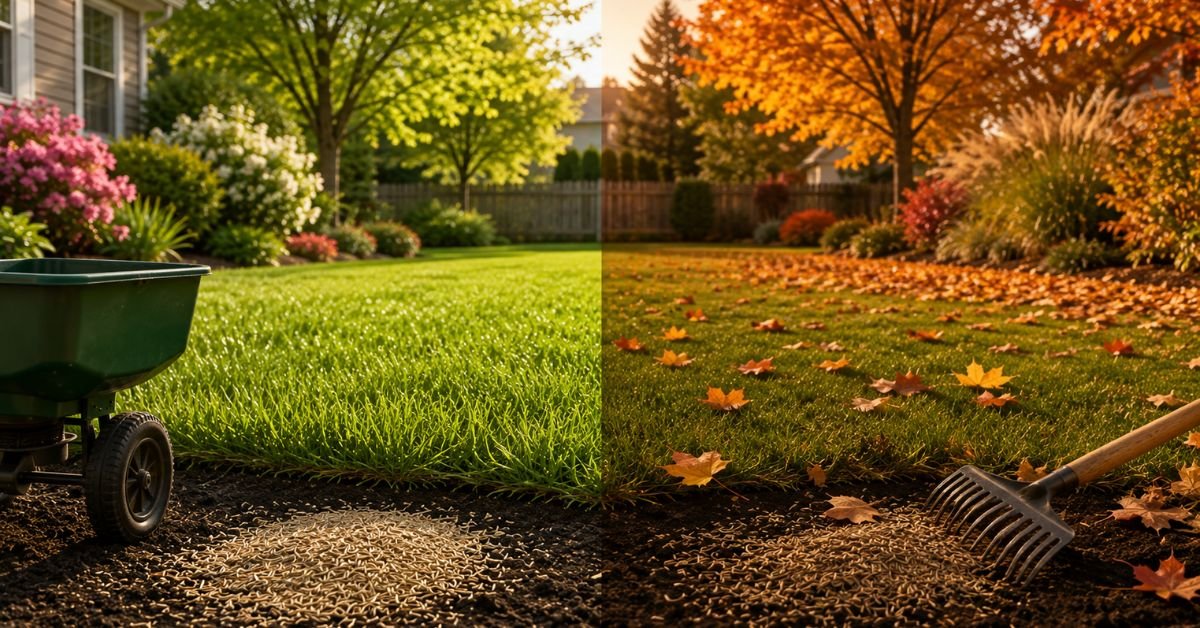
For many cool-season lawns, yes, fall is usually the better choice.
Spring has one obvious advantage: the growing season is ahead of you. But that does not automatically make it easier.
A spring-seeded cool-season lawn can face increasing weed competition and then summer heat before the young plants have developed a strong root system. University Extension programs commonly point to these challenges when comparing spring and fall establishments.
Fall often provides a more comfortable combination of:
Warm soil for germination.
Cooler air for cool-season growth.
Less weed competition.
Time for establishment before the next summer.
Spring still has a place. A homeowner who misses the fall window may have a perfectly reasonable reason to seed in spring, especially for a smaller repair.
Personal Pro-Tip: I would not leave a badly damaged lawn bare for months just because fall is technically the better season. A carefully managed spring repair can still make sense.
Can You Plant Grass Seed in Summer?
The answer depends heavily on the grass.
For cool-season grasses, summer is often the most difficult period for establishment. Iowa State University Extension describes late May through mid-August seeding in Iowa as extremely difficult and usually unsuccessful.
That does not mean those exact dates apply to every state. It means hot conditions can create a difficult environment for cool-season seedlings.
Warm-season grasses are different because their active growth period occurs during warm weather.
So when someone asks, “Can I plant grass seed in summer?”, my first response is:
“Which grass?”
Personal Pro-Tip: Never apply a tall-fescue planting calendar to bermudagrass or another warm-season lawn. The biology is different.
Best Time to Plant Grass Seed When Overseeding a Lawn
Overseeding is not the same as starting a completely new lawn.
With overseeding, the seed has to compete with existing turf and reach suitable soil contact. That makes preparation especially important.
For many cool-season lawns, late summer to early fall is a strong overseeding period. Iowa State University Extension recommends mid-August through mid-September for renovation work in Iowa.
Before throwing more seed onto a thin lawn, figure out why it became thin.
Common causes include:
- Shade
- Compacted soil
- Poor drainage
- Drought
- Heavy traffic
- Poor mowing practices
- Unsuitable grass
- Disease or pests
If the underlying problem remains, more seed may only provide a temporary improvement.
Personal Pro-Tip: If a section keeps thinning every year, I would investigate the cause before buying another bag of seed.
Best Time to Repair Bare Spots in a Lawn
Small bare patches are usually simpler to repair than an entire lawn, but timing still matters.
For a cool-season lawn, use the strongest local growing period whenever possible.
Start by removing dead material and exposing enough soil for the seed to make contact. Spread the appropriate seed, lightly prepare the surface according to the grass and product guidance, and keep the area appropriately moist during germination.
Do not ignore the reason the patch became bare.
A path used by pets, a heavily shaded corner, compacted soil, or poor drainage can cause the same problem again.
Personal Pro-Tip: I would rather spend ten minutes figuring out why a patch failed than repeatedly reseeding the same spot.
How to Choose Grass Seed Before You Worry About Timing
Timing comes after choosing the right grass.
Before buying seed, consider:
Climate: Is the species suitable for your region?
Sunlight: Does your lawn receive enough light?
Traffic: Will children, pets, or frequent foot traffic use the area?
Soil: Does the site drain well or stay wet?
Shade: Is the area exposed or heavily shaded?
Seed mixture: Are the species in the blend appropriate for your conditions?
Iowa State University Extension notes that grass selection should match site conditions. It also points out that Kentucky bluegrass generally performs best in sunny locations, while certain fine fescues can handle shade more effectively.
Personal Pro-Tip: I pay attention to the seed label instead of choosing a bag based only on the picture and marketing claims on the front.
How to Prepare Soil Before Planting Grass Seed
Good timing cannot compensate for poor preparation.
For a new lawn, remove debris, deal with obvious drainage problems, address major grading issues, and create a suitable seedbed.
A soil test can be useful when you suspect a pH or nutrient problem. I would not automatically add lime or fertilizer simply because a generic article says every lawn needs it.
Your goal is straightforward:
Create soil conditions that allow seed to contact the soil, receive moisture, and develop roots.
For serious soil problems, local university Extension recommendations can be more useful than a one-size-fits-all lawn formula.
Personal Pro-Tip: Put your effort into the seedbed. Grass seed cannot fix severely compacted, poorly drained, or badly prepared soil by itself.
How to Plant Grass Seed for Better Germination
Once the site is prepared, concentrate on even distribution and good seed-to-soil contact.
Spread seed evenly
A broadcast or drop spreader usually makes large areas easier to seed consistently.
Use two directions
Applying approximately half the seed in one direction and the remaining portion at a right angle can improve coverage.
Keep seed placement shallow
Grass seed generally does not need to be buried deeply.
Improve seed-to-soil contact
Light raking or another appropriate method can help position seed against the soil.
Maintain moisture
The seedbed should remain appropriately moist during germination without staying constantly saturated.
Limit traffic
New seedlings need time before they can handle normal foot traffic.
Personal Pro-Tip: Uneven seed distribution is one of the easiest mistakes to prevent. I would rather spend a little more time spreading seed evenly than try to correct stripes and bare areas later.
What to Do After Planting Grass Seed
The work does not end when you finish seeding.
During germination, watch moisture closely. As seedlings develop, irrigation can gradually be adjusted to support deeper root development and the needs of the growing lawn.
Do not treat newly emerged grass exactly like established turf. Young seedlings have small root systems and can be especially vulnerable to heat and drought.
For overseeding, the existing lawn also needs to be managed so the new seedlings have an opportunity to establish.
Personal Pro-Tip: The first green shoots are a milestone, not the finish line. I give new grass time to establish before expecting it to behave like a mature lawn.
When Should You Mow Newly Seeded Grass?
Do not choose your first mowing date solely from a calendar.
Grass grows at different speeds depending on species, temperature, moisture, sunlight, and other conditions.
Instead, wait until the seedlings are established enough to tolerate mowing and avoid removing too much leaf tissue at once.
Keep mower blades sharp and avoid creating unnecessary stress on very young turf.
Personal Pro-Tip: I trust the condition and height of the grass more than a generic “mow after two weeks” rule.
Common Grass Seed Planting Mistakes
Planting the wrong grass
A perfect planting date cannot fix an unsuitable grass species.
Following a calendar blindly
Weather varies from year to year.
Planting cool-season grass during severe summer heat
Heat and drought can make establishment extremely difficult.
Waiting until the very end of fall
Seed may germinate too slowly or have too little time to establish before winter.
Poor seed-to-soil contact
Seed sitting on top of dense turf or thatch may not establish well.
Overwatering
More water does not automatically mean faster establishment.
Guessing about fertilizer
Applying unnecessary nutrients can create problems rather than solve them.
Using pre-emergent herbicide at the wrong time
Many pre-emergent herbicides are designed to prevent seeds from germinating. That can include desirable grass seed.
Iowa State University Extension warns that most pre-emergent herbicides are not compatible with cool-season grass seeding unless the product is specifically labeled for that use.
Personal Pro-Tip: If I am seeding a lawn, I read the herbicide label before applying any weed-control product. Seed and pre-emergent schedules can conflict.
Grass Seed Troubleshooting: Why Did My Lawn Fail?
The seed has not germinated
Check moisture, soil temperature, planting depth, seed-to-soil contact, and the quality or storage history of the seed.
Some grass species naturally germinate faster than others, so do not judge every lawn by the same timeline.
Seedlings appeared and then disappeared
Look at drought, excessive moisture, heat, traffic, pests, and other stress factors.
Germination is uneven
Uneven spreading, inconsistent moisture, different soil conditions, and shade can all create patchy establishments.
The lawn remains thin
Do not automatically add more seeds. Investigate sunlight, soil compaction, drainage, grass selection, and mowing practices.
Spring lawn is covered in weeds
Spring-seeded cool-season lawns can face substantial weed competition.
Personal Pro-Tip: When a lawn fails, I diagnose before reseeding. Otherwise, you can spend money fixing the symptom while the real problem remains.
Is Grass Seed Safe for Cats and Dogs?

The grass seed itself is usually not the main pet-safety concern I would focus on during lawn establishment.
The bigger concern is often what you apply around the seed, including fertilizers, herbicides, and insecticides.
ASPCA recommends following product directions and keeping pets away from treated areas as instructed. Lawn-care products should also be stored securely where pets cannot reach them.
If you use a lawn product, read the actual label rather than assuming it is safe because it is sold for residential lawns.
If a pet may have ingested a potentially harmful lawn product, contact a veterinarian promptly.
Personal Pro-Tip: I treat every lawn treatment as a separate safety decision. “For lawns” does not automatically mean “safe for pets.”
What If You Missed the Best Time to Plant Grass Seed?
Missing the ideal window does not automatically mean the project is impossible.
First, check:
What grass am I planting?
What are the soil conditions?
Can I maintain appropriate moisture?
What weather is coming?
How much favorable growing time remains?
Am I repairing a small patch or renovating the entire lawn?
A small repair may make sense even when a large renovation would be risky.
Sometimes the smartest lawn decision is simply to wait.
Personal Pro-Tip: I would rather delay a large project than spend money seeding thousands of square feet during clearly unfavorable conditions.
When Is It Too Late to Plant Grass Seed?
There is no single nationwide cutoff date.
For cool-season grass, the key question is whether the seedlings can establish before the next major period of stress, such as severe summer heat or winter cold.
For warm-season grass, the concern may be whether enough warm growing weather remains before temperatures fall.
This is why “too late” should be treated as a conditions question, not a date on the calendar.
Personal Pro-Tip: When someone asks me whether it is too late, I look at the grass, the weather, and the time remaining for establishment before I look at the date.
New Lawn, Overseeding, or Bare Patch? The Timing Can Differ
These three jobs are often treated as one problem, but they are not.
New lawn: You are starting from prepared soil, so seedbed preparation and distribution are major priorities.
Overseeding: Existing grass creates competition, so seed-to-soil contact becomes especially important.
Bare patch: The patch may be small, but the reason it became bare needs attention.
That distinction makes the question “What is the best time to plant grass seed?” much easier to answer.
Personal Pro-Tip: Before choosing the date, I decide what kind of seeding project I am actually doing.
When Grass Seed Is Not the Best Solution
Sometimes adding seed is not the real answer.
A lawn may repeatedly fail because of:
- Heavy shade
- Poor drainage
- Severe compaction
- Unsuitable grass species
- Repeated drought stress
- Excessive traffic
- An underlying soil problem
If the conditions are fundamentally wrong for turfgrass, adding more seed may only give you temporary green coverage.
University Extension guidance also recognizes that heavily shaded areas may be poor candidates for conventional turfgrass.
The practical lesson is simple:
More seed does not always mean more grass.
Personal Pro-Tip: If one area dies every year, stop asking how much seed to add and start asking why that area cannot support the grass.
A Simple “Should I Plant Grass Seed Now?” Decision Guide
When I need to make the decision quickly, I use this order.
Step 1: Identify the grass
Is it cool-season or warm-season?
Step 2: Check your location
Consider your region, USDA Hardiness Zone, elevation, and local climate.
Step 3: Check the soil
Is it workable? Is moisture available? Can seeds make good contact with the soil?
Step 4: Check the weather ahead
Are severe heat, drought, heavy rain, or cold conditions approaching?
Step 5: Look beyond germination
Will the seedlings have enough favorable weather to establish?
Step 6: Choose your action
Good conditions: Plant.
Borderline conditions: Consider adjusting your timing or project size.
Poor conditions: Wait for a more suitable window.
That is the system I would use instead of memorizing a single national planting date.
Personal Pro-Tip: Remember this order: grass type, location, soil, weather, then calendar.
Best Time to Plant Grass Seed: 7 Common Questions
Q1. What is the best time to plant grass seed?
For many cool-season grasses, late summer to early fall is generally the strongest planting period. Warm-season grasses are usually better established during late spring or early summer.
Q2. Is fall better than spring for grass seed?
For many cool-season lawns, yes. Fall commonly provides favorable temperatures and less weed competition, while spring seedlings may face summer heat before they are fully established.
Q3. What is the best month to plant grass seed?
There is no universal best month. Late summer and early fall are common targets for cool-season grasses, while late spring and early summer are generally more suitable for many warm-season grasses.
Q4. Can I plant grass seed in summer?
It depends on the grass. Summer can be difficult for cool-season grasses, while warm-season grasses are adapted to active growth during warm conditions.
Q5. How do I know if it is too late to plant grass seed?
Check the grass type, soil conditions, upcoming weather, and the amount of favorable growing time remaining. There is no single cutoff date for the whole United States.
Q6. When should I oversee my lawn?
For many cool-season lawns, late summer to early fall is a strong overseeding window. First determine why the lawn became thin so you do not repeat the same problem.
Q7. Is soil temperature more important than the calendar?
Both matter, but soil and weather conditions can give you a better indication of whether grass seed has a realistic chance to germinate and establish than the calendar alone.
Personal Pro-Tip: If two lawn-care guides give you different dates, check whether they are talking about the same grass and the same region before deciding that one of them is wrong.
Final Thoughts on the Best Time to Plant Grass Seed
The best time to plant grass seed is not simply a date printed on a calendar. It is a period when your grass, soil, moisture, temperature, and remaining growing season line up.
For many cool-season lawns, that means late summer to early fall. For many warm-season grasses, it means late spring to early summer.
But the best lawn decisions go one step further.
Choose a grass that fits your climate and yard. Prepare the soil before you seed. Plant when conditions are favorable. Keep the seedbed appropriately moist. Give young grass time to establish. And when a lawn keeps failing, look for the underlying cause instead of automatically adding more seed.
That is the approach I would take with any lawn project: choose the grass first, then choose the planting window.
Have you had better results planting grass seed in spring or fall? Share your grass type and region in the comments, or ask your lawn question below.

Amin Khalid is a professional horticulturist and the founder of LeafyWisdom. With a deep passion for home gardening and horticultural research, he specializes in providing practical, easy-to-follow care guides for indoor plants. Amin’s goal is to simplify gardening for everyone and help fellow plant lovers build their own thriving green spaces.


No responses yet