
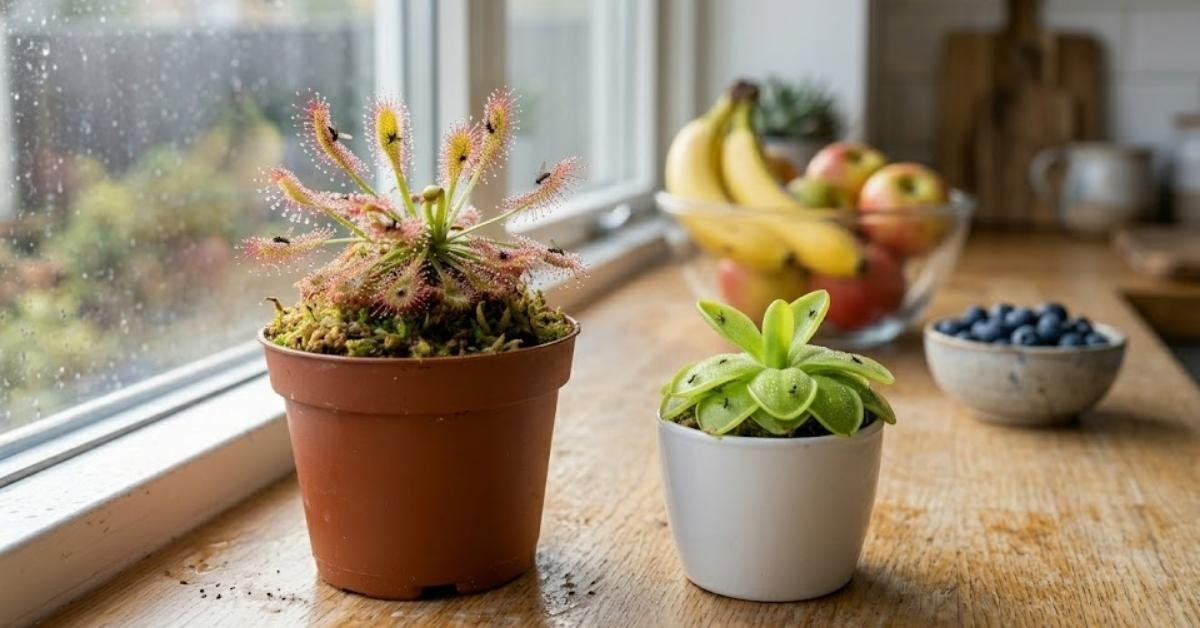
We’ve all been there. You bring home a beautiful bunch of bananas from the grocery store, and three days later, your kitchen feels like a landing strip for fungus gnats and fruit flies. In my 15 years of professional horticulture, I’ve seen people try everything from vinegar bowls to those sticky yellow cards that look like a middle school art project. But if you want a solution that actually adds beauty to your home, you should look into the best carnivorous plants for gnats in kitchen environments.
Using plants as pest control isn’t just “cool”—it’s effective. However, these aren’t your typical houseplants. You can’t just stick them in a pot of hardware-store dirt and hope for the best. To make this work, you need to understand how these specialized plants survive in the wild and how to mimic those conditions right next to your fruit bowl.
Quick Care Guide for Kitchen Carnivores
| Feature | Requirement | Expert Observation |
| Light | Bright, Direct/Indirect | Most need a sunny South-facing windowsill. |
| Water | Distilled or Rainwater | Never use water straight from the faucet. |
| Soil | Peat/Perlite Mix | Never use standard potting soil with fertilizers. |
| Humidity | 50% – 70% | High humidity is key, especially when the AC is blasting. |
| Temperature | 65°F – 80°F | Keep them away from cold drafts or heater vents. |
Why the Best Carnivorous Plants for Gnats in Kitchen Areas Outperform Sprays
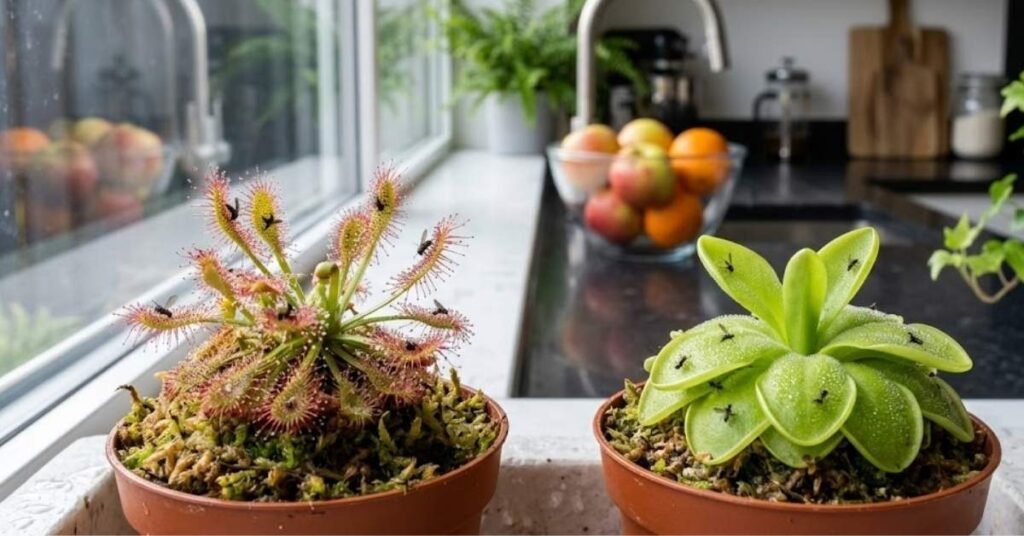
When I first started outfitting kitchens with “predatory plants,” I realized that most people think of the Venus Flytrap first. While iconic, a flytrap is actually a poor choice for gnats—their traps are designed for larger bugs like spiders or flies. For the tiny, annoying gnats that plague American kitchens, you need plants with “passive” traps—sticky surfaces that act like living flypaper.
The best carnivorous plants for gnats in kitchen settings are those that lure insects with sweet-smelling nectar and then trap them in a permanent embrace. Not only do these plants help clear the air, but they also don’t involve spraying chemicals near your food prep areas.
Personal Pro-Tip
If you live in a drier climate or run your Air Conditioning year-round, your indoor air is likely too dry for these bog-dwellers. I suggest sitting your pots in a shallow tray of distilled water. This “tray method” keeps the roots wet and boosts local humidity around the leaves.
Which are the Best Carnivorous Plants for Gnats in Kitchen Environments?
If you’re serious about clearing out the pests, you have to pick the right “tool” for the job. In my experience, two specific genera stand head and shoulders above the rest for small insect control.
Sundews (Drosera): The Sticky Solution
Sundews are, bar none, the best carnivorous plants for gnats in kitchen windows. They are covered in tiny tentacles tipped with “dew” (which is actually a super-strong mucilage). When a gnat lands, it’s stuck instantly. My personal favorite is the Drosera capensis. It’s hardy, and I’ve seen a single plant catch dozens of gnats in a single week during a bad Spring outbreak.
Butterworts (Pinguicula): The Living Flypaper
Often called “Pings,” these look like innocent succulents with slightly greasy leaves. Don’t let the cute appearance fool you; those leaves are a death trap for gnats. They are perfect for kitchen counters because they are low-profile and produce beautiful flowers that look like violets. I’ve found that Pinguicula gigantea is particularly effective because both sides of the leaves are sticky.
Personal Pro-Tip
When you buy a Butterwort, check its “cycle.” Many species go through a “succulent phase” in the Fall and Winter where they stop being sticky. If you want year-round gnat control, look for tropical Pings that don’t require a hard dormancy.
My Top Pick: Sundews as the Best Carnivorous Plants for Gnats in Kitchen Spaces
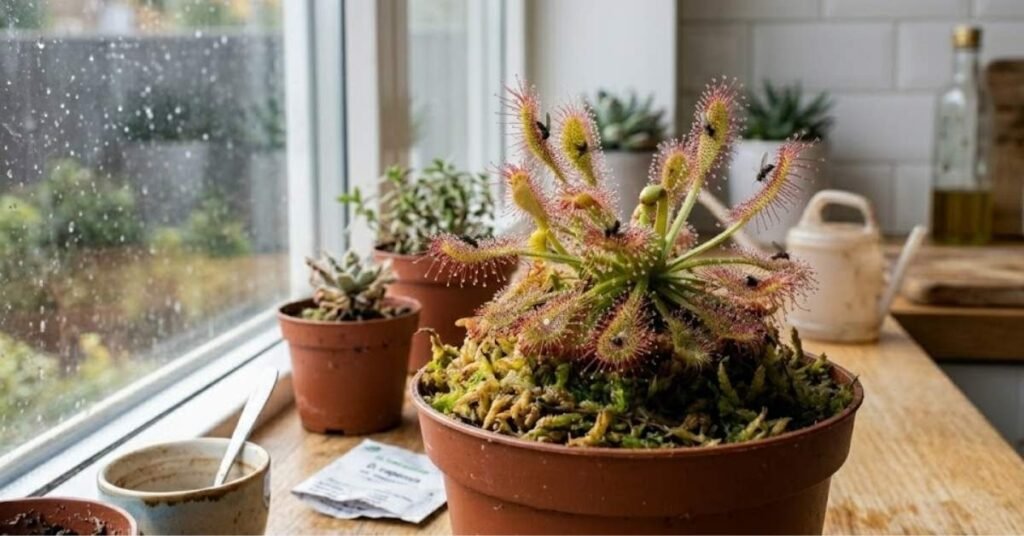
If I had to pick just one plant to handle a gnat infestation, it’s the Cape Sundew. Why? Because they are incredibly communicative. If the “dew” on the leaves disappears, the plant is telling you it’s too dry or needs more light. I’ve grown these in everything from small apartments to large greenhouses, and they are the most reliable hunters I’ve ever seen.
To get the most out of them, place them exactly where the gnats congregate—usually near the sink or the fruit basket. Just make sure that spot gets at least 4-6 hours of sunlight. Without light, the plant won’t produce the nectar that lures the bugs in the first place.
Avoiding Common Mistakes with Your Kitchen Carnivores
I’ve had so many people come to me wondering why their “bug-eater” died after two weeks. In the US, our homes are often set up in ways that accidentally kill these plants.
- The Faucet Mistake: Most American tap water is full of minerals like calcium and sodium. These plants evolved in nutrient-poor bogs. If you water them from the faucet, the minerals will “burn” the roots. You must use distilled water, reverse osmosis water, or collected rainwater.
- The Wrong Dirt: If you use a bag of “Miracle-Gro” or any standard indoor potting soil, your plant will likely die within a month. The fertilizers in those soils are toxic to carnivorous plants. They need a 50/50 mix of unenriched peat moss and perlite.
- AC Vent Placement: We love our Air Conditioning, but these plants hate the dry, moving air it creates. If your kitchen windowsill is directly under an AC vent, your plant will lose its “sticky” dew and won’t be able to catch a single gnat.
Personal Pro-Tip
If you’re wondering if your water is okay, get a cheap TDS (Total Dissolved Solids) meter. If the reading is above 50 ppm, don’t use it. Stick to the bottled distilled water you find at the grocery store.
Troubleshooting: Why is my plant struggling?
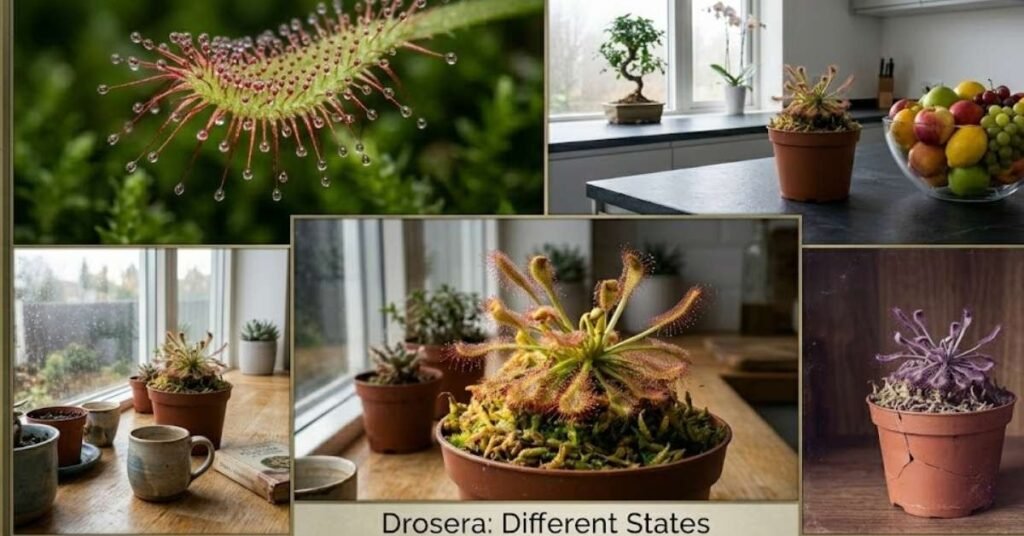
If your best carnivorous plants for gnats in kitchen corners aren’t looking their best, check these common symptoms:
- No “Dew” on Sundews: This usually means the humidity is too low or the light is too dim. Try moving it to a brighter window or placing it in a glass terrarium (with an open top).
- Turning Black/Brown: If the whole plant is turning black, it’s likely root rot (if it’s sitting in too much water) or mineral burn (from the wrong water). If it’s just one leaf, don’t worry—old leaves die off naturally as new ones grow.
- Stretching/Pale Color: This is “etiolation.” The plant is hungry for light. American kitchens can be dark, so you might need a small LED grow light to keep the plant vibrant.
Toxicity Warning: Are they safe for your pets?
This is a major concern for US pet owners. I’m happy to report that Sundews and Butterworts are generally considered non-toxic to cats and dogs. Unlike a Lily or a Poinsettia, these plants won’t cause an emergency vet visit if your curious cat takes a nibble.
However, the “dew” can be a bit of a sticky mess on fur, and some specialized carnivorous plants (like certain Pitcher plants) have digestive enzymes that might cause a mild stomach upset if ingested in large quantities.
Personal Pro-Tip
Even though they aren’t toxic, I keep my plants on a higher shelf or in a hanging glass orb. Cats love the “sparkly” look of Sundews and will often bat at them, which ruins the delicate sticky tentacles the plant uses to catch gnats.
FAQS: What People Actually Ask About Carnivorous Plants for Gnats
1. Can I use these plants instead of bug spray?
Yes! I’ve seen a healthy collection of Sundews and Pings completely replace the need for chemical traps. They won’t wipe out an infestation overnight, but they provide constant, long-term “background” control.
2. Do I need to “feed” them if there are no gnats?
In most US homes, there’s always a bug or two. But if your kitchen is surgically clean, you can use a highly diluted foliar spray (like Maxsea) once a month. Just be careful not to overdo it.
3. Do these plants smell bad?
Not at all. Unlike the “Corpse Flower” or some large tropicals, Sundews and Butterworts have a very faint, sweet scent that is undetectable to humans but irresistible to gnats.
4. My Venus Flytrap isn’t catching gnats. Why?
As I mentioned, the “best” carnivorous plants for gnats in kitchen settings aren’t flytraps. Flytraps are like a bear trap—gnats are just too small to trigger the hairs. Stick with Sundews or Butterworts for the tiny stuff.
5. Do they need to go outside in the Summer?
Depending on your USDA Hardiness Zone, they can! Most of these plants thrive outdoors in Zones 8-10. However, if you live in Zone 5 or 6, keep them inside or they’ll freeze.
6. Can I use “Spring” water from the store?
No! “Spring” water actually has more minerals added for taste. Stick to Distilled or Purified water labels.
7. Why do the traps on my plant keep turning black?
Each trap has a “shelf life.” After it eats 2-3 bugs, that specific leaf or trap will die off. It’s totally normal! Just snip it off with clean scissors to keep the plant looking tidy.
Final Thoughts on Your Kitchen Jungle
Finding the best carnivorous plants for gnats in kitchen windows is a rewarding journey. It turns an annoying household problem into a fascinating hobby. Just remember: keep them wet, keep them bright, and keep that faucet water far away from their roots!

Amin Khalid is a professional horticulturist and the founder of LeafyWisdom. With a deep passion for home gardening and horticultural research, he specializes in providing practical, easy-to-follow care guides for indoor plants. Amin’s goal is to simplify gardening for everyone and help fellow plant lovers build their own thriving green spaces.

No responses yet