
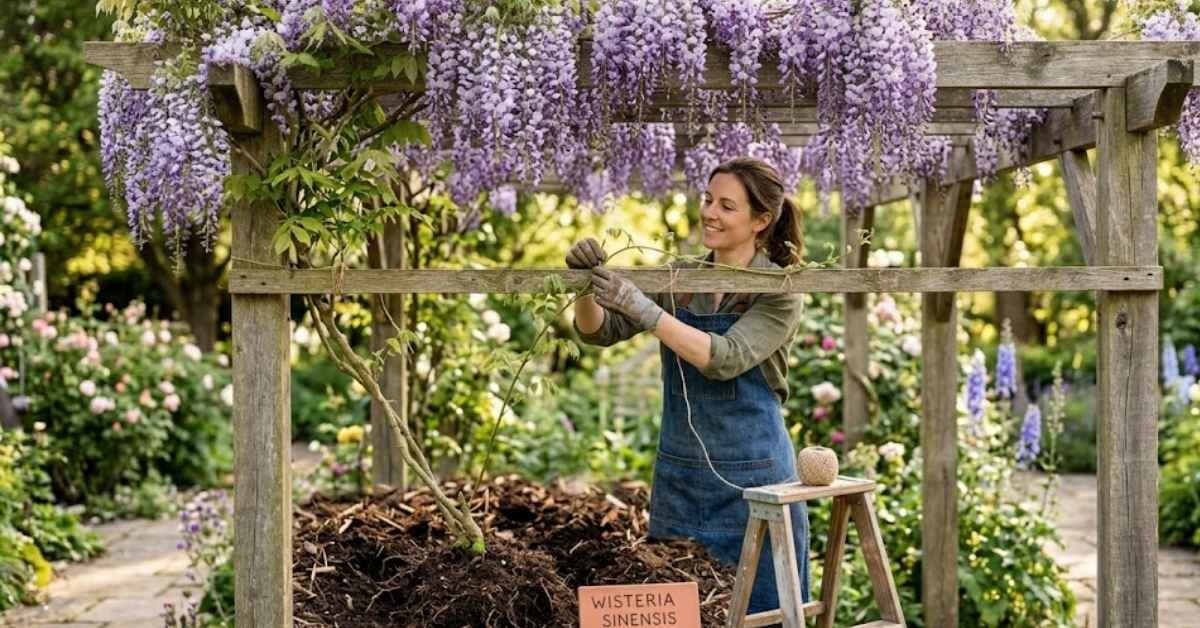
If you want to learn how to plant and train a wisteria tree, there’s one thing you need to understand first: it isn’t actually a tree. What you’re really doing when you plant and train a wisteria tree is shaping a vigorous climbing vine into a tree-like form over time. You’ve probably seen photos of a perfectly trained wisteria tree covered in cascading purple blooms, but achieving that look depends entirely on how you plant and train a wisteria tree from the very beginning. Get this foundation right, and everything else becomes much easier.
What You’re Actually Growing

A wisteria standard is a woody vine coaxed upright on a single trunk over several years. It is not a self-supporting tree — it never will be — which means a permanent stake isn’t optional, it’s structural. The reward for understanding this is a globe-shaped canopy of drooping flower clusters at nose level, one of the most dramatic plants you can keep in a garden.
Toxicity note: All parts of the plant are toxic. Seeds and pods carry the highest concentration. Keep wisteria away from areas where children and pets play freely, and wash your hands after handling the seed pods in late summer.
Choosing the Right Variety
For tree-form training, two varieties stand above the rest. Silky wisteria (W. brachybotrys) has moderate vigor and responds well to shaping. Kentucky wisteria (W. macrostachya) is similarly manageable and handles cold down to Zone 4. Japanese and Chinese wisterias are beautiful but so vigorous they’re harder to control as standards — and both are considered invasive in much of the eastern United States. If you’re in that region, native American wisteria (W. frutescens) is a well-behaved alternative.
Whatever variety you choose, buy a grafted plant. Seed-grown wisteria can take 10–20 years to bloom, if ever. A grafted plant flowers in 3–5 years. Look for a slight swelling near the base of the stem; that’s the graft union.
Picking the Right Spot
Wisteria is forgiving about soil but uncompromising about sun. It needs a minimum of six hours of direct light per day — less than that and you’ll get lush growth with zero flowers. A south- or west-facing position is ideal in the Northern Hemisphere.
Soil should be moist but well-drained, slightly acidic to neutral (pH 6.0–7.0). Heavy clay needs compost and coarse grit worked in before planting. Avoid anywhere that holds standing water.
Keep the plant at least 10–15 feet from your house. Wisteria roots are powerful enough to crack foundations, lift paving, and pry open gutters. Keep it equally clear of other trees — given the chance, it will climb and strangle them.
Planting: Step by Step

When to plant: Spring (March–April) is best for bare-root plants. Autumn (September–November) suits container-grown plants well. Avoid planting into extreme heat or hard frost.
What you’ll need: spade, compost, a galvanized steel post (at least 6 ft long), soft tree ties, mulch, and pruning shears.
- Dig the hole twice as wide as the root ball and deep enough so the crown sits about one inch below the soil surface. Mix compost into the backfill.
- Soak bare-root plants for 2–4 hours before planting. Bare roots die within minutes if left exposed to wind or sun — don’t rush this step.
- Plant and firm. Arrange bare roots outward, fill in carefully to eliminate air pockets, and build a small soil ridge around the perimeter to form a watering basin.
- Water deeply until the basin fills and soaks in slowly. This settles the soil and gets roots in contact with the ground.
- Install the stake immediately. Drive a galvanized steel pipe or heavy 4×4 post at least 12–18 inches into the ground, 3–6 inches from the trunk, standing 4–5 feet above ground. Wood eventually rots or gets overwhelmed by a swelling trunk; steel lasts indefinitely. This stake will be permanent.
- Tie the trunk every 8–10 inches from the ground up using soft tree ties. Snug enough to support, loose enough to let the stem expand. Check every 3–6 months.
- Mulch with a 2-inch layer of bark chips or straw around the base, keeping it clear of the stem itself.
Training: Year by Year
Patience is the price of admission. Plan for 3–5 years before the first flowers.
Year 1 — Build the trunk. Choose one strong stem as your future trunk and remove everything else. Strip all side shoots from that stem as they appear, and tie it to the post every 8–10 inches as it grows. Let it climb to the top of the post without pruning the tip.
Year 2 — Start the canopy. Once the main stem grows about 12 inches above the post, cut the tip just above a bud at post height. This forces the plant to push out side shoots. Allow 3–5 of the strongest to grow outward as your canopy framework; remove the rest. When those side shoots reach 6 leaves, cut just above the sixth leaf to encourage branching.
Year 3 onward — The two-cut method. This is what separates growers who get flowers from those who don’t. In summer (July–August), cut all new whippy shoots back to 5–6 leaves from the main framework. In late winter (February), cut those same stems back further to just 2–3 buds — about 4 inches. Summer pruning controls the plant’s energy; winter pruning develops the short, stubby spurs that actually produce flowers. Miss the winter cut, and you’ll get magnificent leaves the following spring with almost no blooms.
Throughout every year: remove any shoots growing from below the graft point or from the base. These are rootstock suckers — they look similar to the named variety but will eventually take it over if ignored.
Watering and Feeding

In the first year, water deeply twice a week for the first two to three months, then once a week during dry spells. Established wisteria is drought-tolerant; water only when rainfall drops below an inch per week.
On fertilizer, this is where most beginners go wrong. Wisteria is a legume — it fixes its own nitrogen. Apply a high-nitrogen feed and you’ll grow a magnificent green shrub that never flowers. Use a high-potassium fertilizer (tomato feed or a 5-10-10 granular) once in early spring. A mulch of well-rotted compost in autumn is usually enough for established plants.
Mistakes Worth Avoiding
Planting too close to the house is the most expensive error. Roots and woody stems will find foundations, drains, and paving. The 10–15 foot clearance rule isn’t cautious — it’s the minimum.
Using a weak stake is the second-most common. A bamboo cane cannot support a mature wisteria tree. If you start with flimsy support, you’ll be digging it all up later. Buy the steel pipe once and be done with it.
Skipping the winter pruning is the reason most wisteria owners never see flowers. Summer pruning alone keeps the plant tidy but doesn’t build flower spurs. Both cuts are essential, and February is the window.
Over-fertilizing with nitrogen compounds the flowering problem. If your wisteria is putting on yards of leafy growth every year and producing no blooms, nitrogen is almost always the culprit alongside insufficient pruning. Switching to high-potash feed and committing to the two-cut method will usually turn things around within a season or two.
Buying a seed-grown plant and expecting flowers in a reasonable timeframe is optimistic to the point of disappointment. Always confirm the plant is grafted before you buy.
Quick Reference
| Factor | Requirement |
| Sunlight | Full sun, 6+ hours/day |
| Soil | Moist, well-drained, pH 6.0–7.0 |
| Planting depth | Crown 1 inch below soil surface |
| Watering | Deeply, weekly (Year 1); drought-tolerant once established |
| Feeding | High-potassium fertilizer, spring only |
| Pruning | Twice yearly: July–August and February |
| Staking | Permanent steel or heavy wood post |
| USDA Zones | 4–9 (varies by variety) |
| Time to first bloom | 3–5 years (grafted); potentially never (seed-grown) |
| Toxicity | All parts toxic to humans, pets, and livestock |
Frequently Asked Questions
How long until my wisteria blooms? Grafted plants flower within 3–5 years. Seed-grown plants can take 10–20 years, or never. Always buy grafted.
Why is my wisteria all leaves and no flowers? Almost always one of three things: less than six hours of sun, too much nitrogen, or the winter pruning step being skipped. Work through them in order before assuming something is wrong with the plant.
Can I grow wisteria in a pot? Yes, but only as a trained standard. Use an 18-inch-minimum container, water weekly, feed monthly with high-potash fertilizer, and prune twice a year. Move to a frost-free spot in winter if you’re in Zone 5 or colder.
Is wisteria invasive? Chinese and Japanese varieties are invasive across much of the eastern US. American (W. frutescens) and Kentucky (W. macrostachya) wisteria are native species and safe to plant anywhere.
Should I remove the seed pods? Yes — they’re the most toxic part of the plant, and removing them redirects energy toward next year’s flowers. Wear gloves.
Conclusion
The formula is straightforward: full sun, a steel post, high-potash feed once in spring, and two pruning cuts a year without exception. Start with a grafted plant, give it three years to establish, and resist overcomplicating it. When it finally blooms, you’ll understand why the wait was worth it.Once you understand how to plant and train a wisteria tree, the process becomes simple: full sun, strong support, proper pruning, and patience.

Amin Khalid is a professional horticulturist and the founder of LeafyWisdom. With a deep passion for home gardening and horticultural research, he specializes in providing practical, easy-to-follow care guides for indoor plants. Amin’s goal is to simplify gardening for everyone and help fellow plant lovers build their own thriving green spaces.

No responses yet