
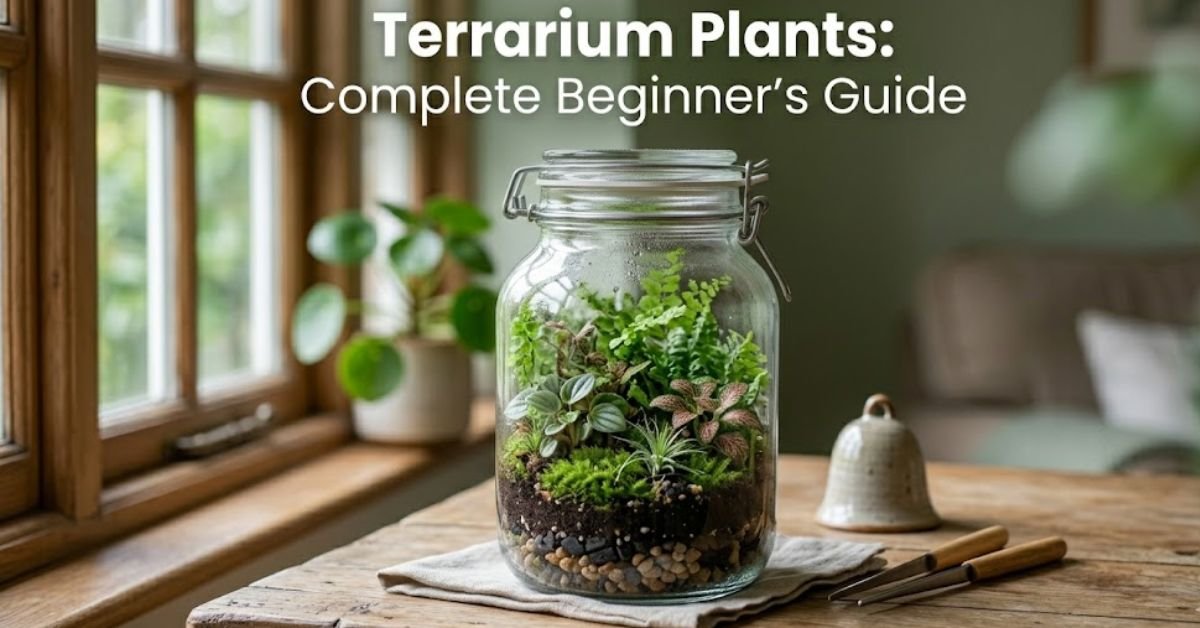
Terrarium plants are the foundation of a healthy miniature ecosystem. Choosing the right plants determines whether your terrarium thrives for years or fails within weeks. In this guide, you’ll discover the best terrarium plants for both closed and open setups, along with expert tips to keep them alive with minimal effort.
Not every plant belongs in a terrarium. The best choices share three key traits:
- Small size — they fit the space without overcrowding
- Slow growth — they won’t outgrow the container in weeks
- Low maintenance — they thrive with minimal fuss once established
The most important rule before choosing any plant: decide on your terrarium type first. Closed and open terrariums are almost opposites in their conditions, and the plants that thrive in one will fail in the other.
Closed vs. Open Terrariums — Know This Before You Buy a Single Plant
This is the section most guides gloss over — and the reason most beginner terrariums fail.
| Feature | Closed Terrarium | Open Terrarium |
| Humidity | Very high (70–90%) | Low to medium (30–50%) |
| Airflow | Minimal | Good |
| Watering | Once a month or less | Every 2–4 weeks |
| Best Plants | Ferns, moss, Fittonia, Pilea | Succulents, cacti, Haworthia |
| Light | Bright indirect only | Direct or bright indirect |
| Self-sustaining? | Yes — can go weeks untouched | No — requires regular checks |
| Beginner-friendly? | Very | Yes, but needs drier soil discipline |
Quick Care Summary Table
| Care Factor | Closed Terrarium | Open Terrarium |
| Light | Bright indirect (no direct sun) | Bright indirect to gentle direct |
| Water | Mist lightly once a month | Every 2–4 weeks when soil is dry |
| Soil | Moisture-retentive tropical mix | Sandy, fast-draining mix |
| Drainage Layer | Pebbles + activated charcoal | Pebbles + sand |
| Temperature | 65–80°F (18–27°C) | 60–85°F (15–29°C) |
| Fertilizer | Rarely — diluted liquid feed once in spring | Once per season at half-strength |
| Repotting | Every 2–3 years | When roots crowd the container |
Best Plants for Closed Terrariums
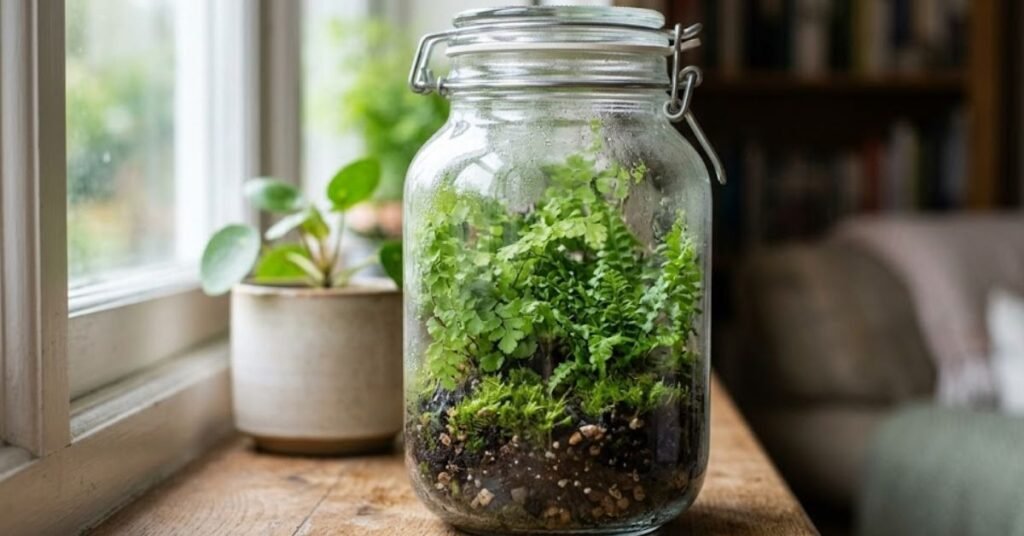
1. Fittonia (Nerve Plant) — Best Overall Beginner Pick
Fittonia is the go-to plant for first-time terrarium builders. Its deep green leaves are criss-crossed with white, pink, or red veins — giving it a striking, mosaic-like look.
It signals when it needs water by wilting dramatically, then springing back to life after a drink. This built-in alarm system makes it nearly impossible to kill.
- Light: Low to medium indirect
- Water: Keep soil moist
- Size: 3–6 inches tall — perfect for small containers
2. Moss — The Foundation of Every Great Closed Terrarium
Moss is not just decoration — it is the backbone of a healthy closed terrarium ecosystem. It covers bare soil, retains moisture, filters the water cycle, and creates that lush, forest-floor look every terrarium builder aims for.
Common terrarium mosses: Cushion Moss (Leucobryum), Sheet Moss (Hypnum), Mood Moss (Dicranum)
- Light: Low — actually prefers shade
- Water: Loves consistent moisture — never let it dry out fully
- Size: Ground-hugging — won’t outcompete other plants
3. Ferns — Instant Tropical Atmosphere
Ferns bring height, texture, and a deeply tropical feel to closed terrariums. The trick is choosing compact varieties — large ferns like Boston Fern quickly outgrow small containers.
Best compact fern choices:
- Maidenhair Fern (Adiantum) — delicate, elegant, loves humidity
- Button Fern (Pellaea rotundifolia) — tough, tolerant, stays small
- Bird’s Nest Fern (Asplenium nidus) — glossy, bold, easy
4. Peperomia — The Set-and-Forget Champion
The entire Peperomia genus is practically born for terrariums. With hundreds of varieties available, there’s a trailing type, a compact mound type, and a bushy type for every design.
They tolerate humidity, indirect light, and occasional neglect better than almost any other terrarium plant.
Top picks: Peperomia caperata (ripple leaf), Peperomia rotundifolia (trailing jade), Peperomia prostrata (string of turtles)
5. Pilea — Color, Texture, and Contrast
Pilea varieties split neatly into two roles in a terrarium: statement plants (larger, feature foliage) and accent fillers (tiny, trailing).
- Pilea involucrata (Friendship Plant) and Pilea mollis (Moon Valley) — statement plants with deeply textured leaves
- Pilea glauca (Silver Sparkle) and Pilea depressa (Baby Tears) — delicate fillers that root wherever they touch soil
6. Creeping Fig (Ficus pumila) — Self-Carpeting Easy Grower
If you want a plant that practically installs itself, drop a Ficus pumila cutting into your terrarium and step back. It roots up fast in humid conditions, carpets bare surfaces, and creates a lush green backdrop for other plants.
Keep it trimmed to prevent it from overwhelming smaller plants.
Closed Terrarium Plants at a Glance
| Plant | Light | Size | Best Role | Toxicity |
| Fittonia (Nerve Plant) | Low–Medium | 3–6 in | Foreground, color | Non-toxic |
| Moss (various) | Low | Ground cover | Base layer | Non-toxic |
| Button Fern | Medium | 6–8 in | Mid-layer | Non-toxic |
| Peperomia | Low–Medium | 4–8 in | Mid-layer, fillers | Non-toxic |
| Pilea glauca | Medium | 2–3 in | Accent filler | Non-toxic |
| Creeping Fig | Low–Medium | Trailing | Ground cover | Mildly irritant |
Best Plants for Open Terrariums
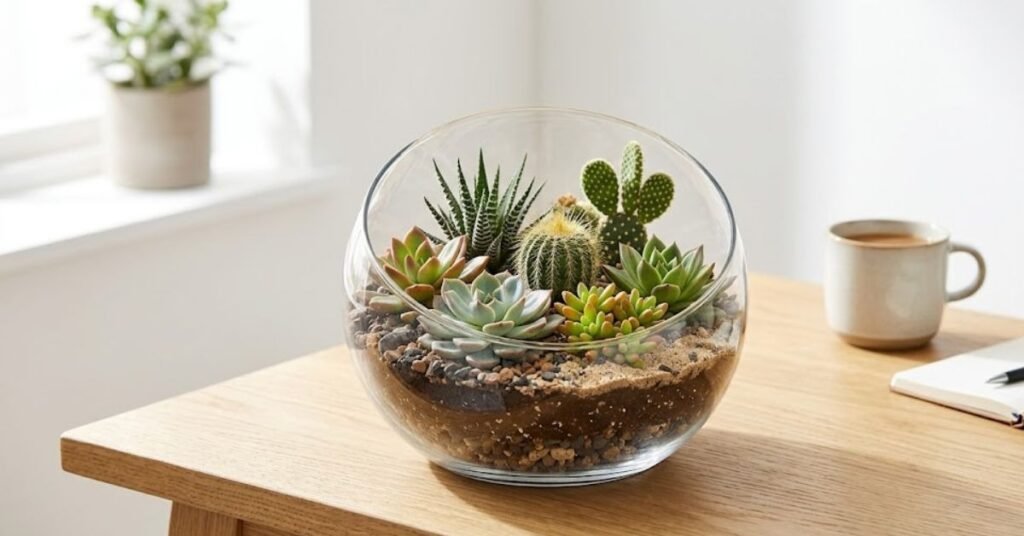
Open terrariums have lower humidity, better airflow, and drier soil. They suit desert-adapted plants perfectly.
Succulents — Easy, Colorful, Forgiving
Succulents store water in their thick leaves, making them ideal for the drier open terrarium environment. Mix different shapes, sizes, and colors for a striking desert landscape.
Top picks:
- Echeveria — rosette form, many colors, very slow-growing
- Haworthia — striped, architectural, tolerates low light (unusual for succulents)
- Crassula (Jade Plant) — classic, drought-tolerant, long-lived
Cacti — The Lowest Maintenance Option
Slow-growing cacti are virtually foolproof in open terrariums. Use a mix of types — tall columnar, rounded barrel, and padded flat shapes — for a dramatic desert display.
- Water every 3–4 weeks (less in winter)
- Always use sandy, fast-draining soil
- Use gloves when planting — obvious, but often forgotten
Air Plants (Tillandsia) — No Soil Needed
Air plants are epiphytes — they get nutrients from air and water, not soil. They can be placed on rocks, driftwood, or tucked into gaps in an open terrarium, creating a truly unique display.
- Mist 2–3 times per week or soak for 20 minutes every 1–2 weeks
- Keep in good indirect light with airflow
- Never let them sit in standing water
How to Build a Terrarium: Layer by Layer
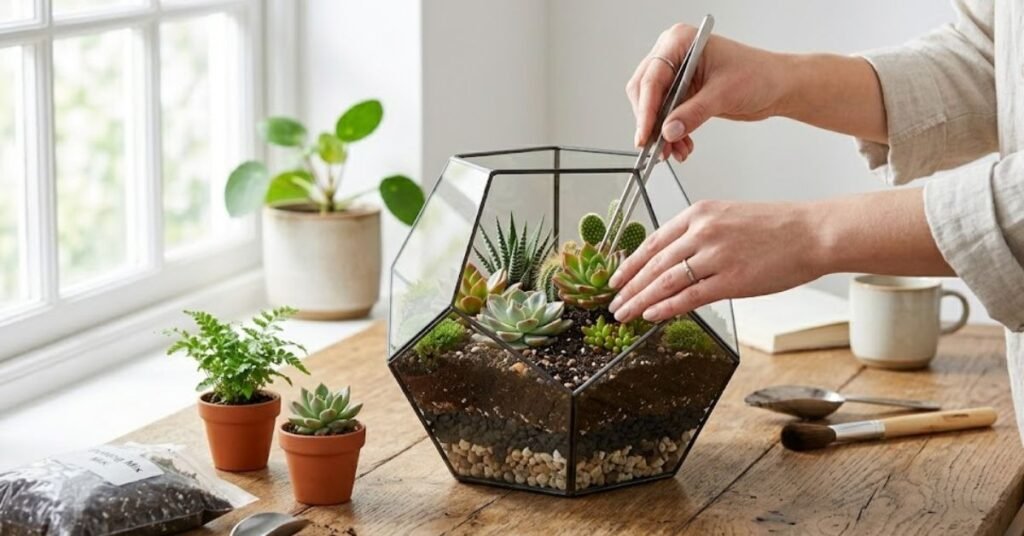
Getting the substrate layers right is what makes the difference between a thriving terrarium and a rotting one.
Closed Terrarium Layers (Bottom to Top)
- Drainage layer (1–2 inches): Pebbles, gravel, or LECA
- Separation layer (thin): Mesh or sheet moss to prevent soil migration
- Activated charcoal (½ inch): Filters water, prevents mold and odor
- Substrate (2–3 inches): Moisture-retentive tropical potting mix
- Top dressing: Decorative moss, small stones, or bark
Open Terrarium Layers (Bottom to Top)
- Drainage layer (1–2 inches): Coarse gravel or pebbles
- Activated charcoal (½ inch): Prevents fungal buildup
- Substrate (2–3 inches): Cactus/succulent mix or sandy loam
- Top dressing: Fine sand, decorative pebbles, or grit
Terrarium Pest and Disease Guide
| Problem | Signs | Fix |
| Fungus Gnats | Tiny flies around soil | Let soil dry; use yellow sticky traps; add carnivorous plant |
| Mealybugs | White cotton clusters on leaves | Remove with alcohol-dipped cotton swab; isolate affected plant |
| Mold on Soil | White fluffy patches | Remove lid; let air circulate for a day; reduce watering; add charcoal |
| Algae on Glass | Green film on inside walls | Too much direct sun; move to bright indirect light; wipe glass |
| Root Rot | Wilting, slimy roots, bad smell | Remove affected plant; let soil dry; improve drainage layer |
| Condensation Buildup | Glass completely fogged, water pooling | Remove lid for a few hours; rebalance moisture level |
Seasonal Terrarium Care Guide
| Season | Closed Terrarium | Open Terrarium |
| Spring | Check for overgrowth; trim if needed; light fertilize | Resume watering; repot crowded plants; fresh top dressing |
| Summer | Keep out of direct sun; remove lid if overheating | Water slightly more; watch for pest activity |
| Fall | Minimal intervention; check moisture level | Reduce watering frequency; check for root crowding |
| Winter | May need zero watering; reduce light exposure | Water very sparingly; move succulents to brightest spot |
Plants to AVOID in Terrariums
Most guides tell you what to use. Fewer tell you what not to use — and that’s often more valuable.
| Plant | Why It Fails |
| Pothos | Grows too fast; takes over in weeks |
| Peace Lily | Needs more space than terrariums allow |
| Spider Plant | Sends out runners that crowd everything |
| Mint | Extremely invasive; will dominate the container |
| Regular Bamboo | Grows too aggressively; breaks glass in some cases |
| Carnivorous plants (most types) | Need special substrate and different humidity than typical terrariums |
Common Beginner Mistakes to Avoid
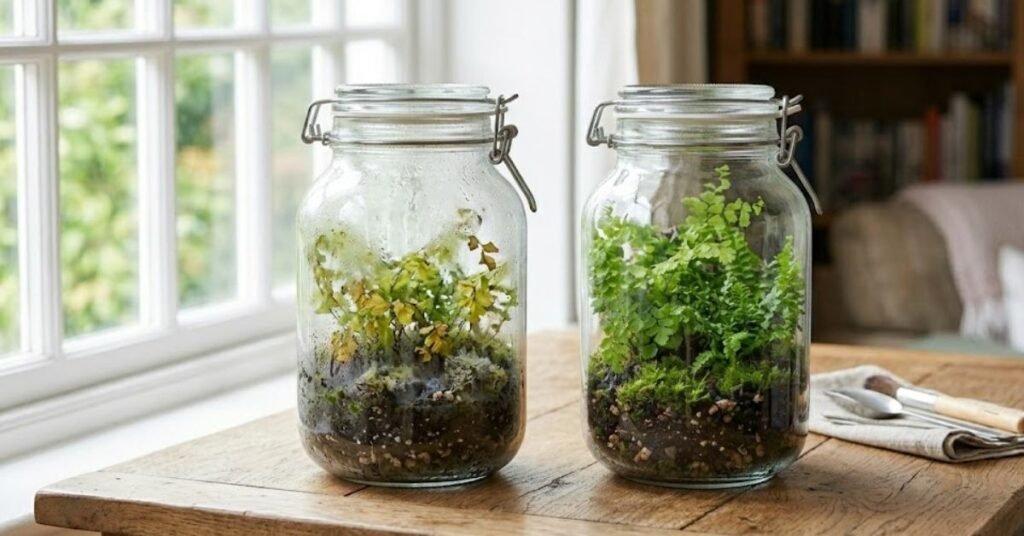
1. Mixing closed and open terrarium plants Succulents and moss cannot coexist. One needs wet soil; the other dies in it. Always match every plant in the container to the same moisture and humidity needs.
2. Skipping the charcoal layer Without activated charcoal, stagnant water in the drainage layer becomes a breeding ground for mold, bacteria, and bad odors. This one layer prevents most closed terrarium failures.
3. Overwatering a closed terrarium A properly built closed terrarium with the right plants barely needs water. If the glass is consistently foggy and water is pooling at the base, you’ve over-watered. Remove the lid for a day or two to rebalance.
4. Placing in direct sunlight, glass magnifies heat. Direct sun turns a terrarium into a slow cooker — scorching leaves and killing plants within days. Always use bright indirect light.
5. Choosing fast-growing plants Plants like pothos or mint look fine for two weeks and then completely take over the container. Always choose confirmed slow growers and miniature varieties.
6. Using regular potting soil without a drainage layer Standard potting soil in a sealed glass container with no drainage becomes waterlogged and anaerobic. Always build your substrate layer properly before planting.
7. Not researching toxicity before buying Several common terrarium plants are toxic to pets and children. Asparagus Fern, Cycas, and Sago Palm are popular choices that can cause serious harm if ingested. Always check before buying.
Toxicity Guide for Common Terrarium Plants
| Plant | Toxic to Pets? | Toxic to Humans? |
| Fittonia (Nerve Plant) | Non-toxic | Non-toxic |
| Peperomia | Non-toxic | Non-toxic |
| Moss (most varieties) | Non-toxic | Non-toxic |
| Pilea | Non-toxic | Non-toxic |
| Asparagus Fern | Toxic to cats & dogs | Mildly irritant |
| Creeping Fig | Mildly toxic | Skin irritant |
| Succulents (most) | Non-toxic | Non-toxic |
| Haworthia | Non-toxic | Non-toxic |
FAQ: Terrarium Plant Questions Answered
1. How often do I water a closed terrarium? A well-built closed terrarium may need watering as rarely as once a month — or even less in winter. The key sign is condensation: if you see some on the glass in the morning that clears by midday, moisture levels are perfect. If no condensation ever appears, mist lightly.
2. Can I put succulents in a closed terrarium? No. Succulents need dry conditions, good airflow, and infrequent watering. The high humidity inside a closed terrarium causes them to rot quickly. Always pair succulents with open terrariums only.
3. Why is my closed terrarium getting moldy? Mold usually means too much moisture, no activated charcoal in the substrate, or a plant that’s beginning to rot. Remove the lid to air it out, take out any decaying plant material, and consider adding charcoal to your substrate if you didn’t originally.
4. What is the easiest terrarium plant for a beginner? Fittonia (Nerve Plant) is the top choice. It’s forgiving, visually striking, signals its water needs clearly, and thrives in the humid closed terrarium environment with minimal care.
5. How long does a closed terrarium last? A well-built closed terrarium with the right plants can last for years — even decades with occasional maintenance. The world record for an unwatered closed terrarium is over 40 years.
Conclusion
The secret to a thriving terrarium is simple: match your plants to your container, build your substrate layers correctly, and resist the urge to overwater.
Start with a closed terrarium using Fittonia, moss, and Peperomia — three forgiving, beginner-friendly plants that practically take care of themselves once established. Get that right, and you’ll be building more complex terrariums within months.
Ready to start? Pick up a glass container with a lid, a bag of activated charcoal, and two or three Fittonia plants from your local nursery or garden center. Your first thriving mini-ecosystem is closer than you think.
Have a question about your terrarium? Drop it in the comments — we answer every one.
Amin Khalid is a professional horticulturist and the founder of LeafyWisdom. With a deep passion for home gardening and horticultural research, he specializes in providing practical, easy-to-follow care guides for indoor plants. Amin’s goal is to simplify gardening for everyone and help fellow plant lovers build their own thriving green spaces.