
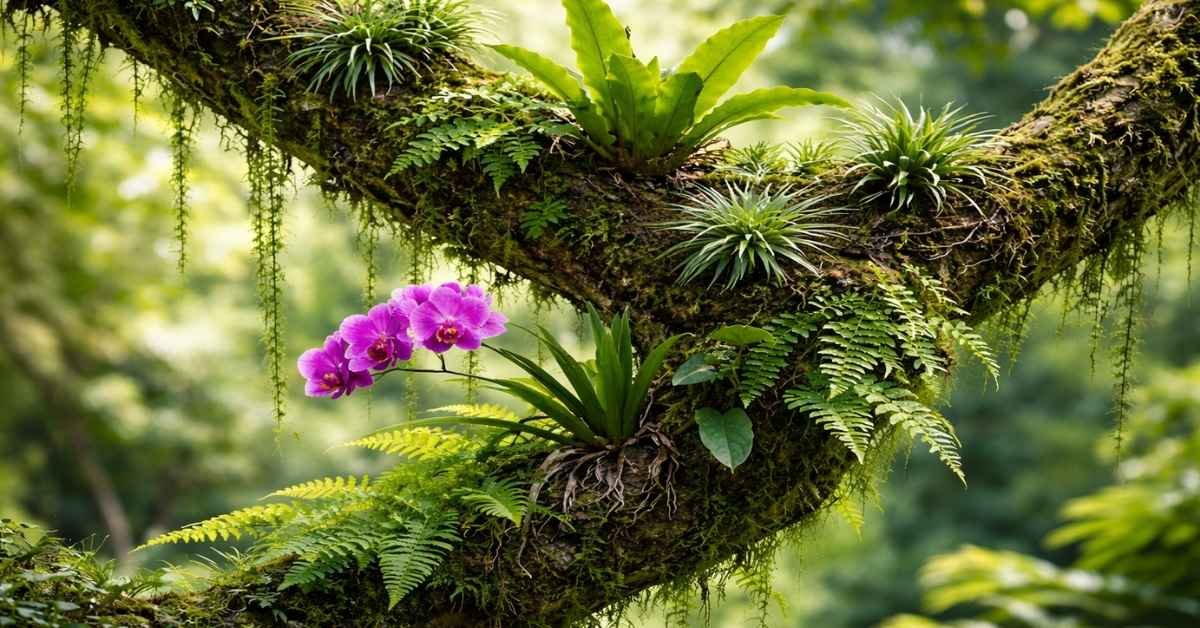
Have you ever noticed a lush fern growing straight out of a tree trunk? Or an orchid clinging to a mossy branch with no soil in sight? These are called epiphyte plants that grow ON other plants. They’re one of nature’s most fascinating survival strategies, and yes, you can grow them in your home.
This guide covers everything you need to know: what they are, which ones to try, how to care for them, and the mistakes most beginners make.
What Are “Plants on Plants”? (Epiphytes Explained Simply)
An epiphyte is a plant that uses another plant, usually a tree as a surface to grow on. The word comes from Greek: epi (“upon”) + phyton (“plant”).
Here’s the key thing: epiphytes are NOT parasites. They don’t steal water or nutrients from the host tree. They just borrow the space. All their food and water comes from:
- Rain and humidity in the air
- Leaf litter and organic debris that collects around them
- Their own specialized roots or leaves
This relationship is called commensalism: one organism benefits, while the other is completely unaffected.
Did You Know? About 10% of all vascular plant species on Earth are epiphytes; that’s over 28,000 species!
The Two Main Types of Plants That Grow on Other Plants
1. Holo-Epiphytes
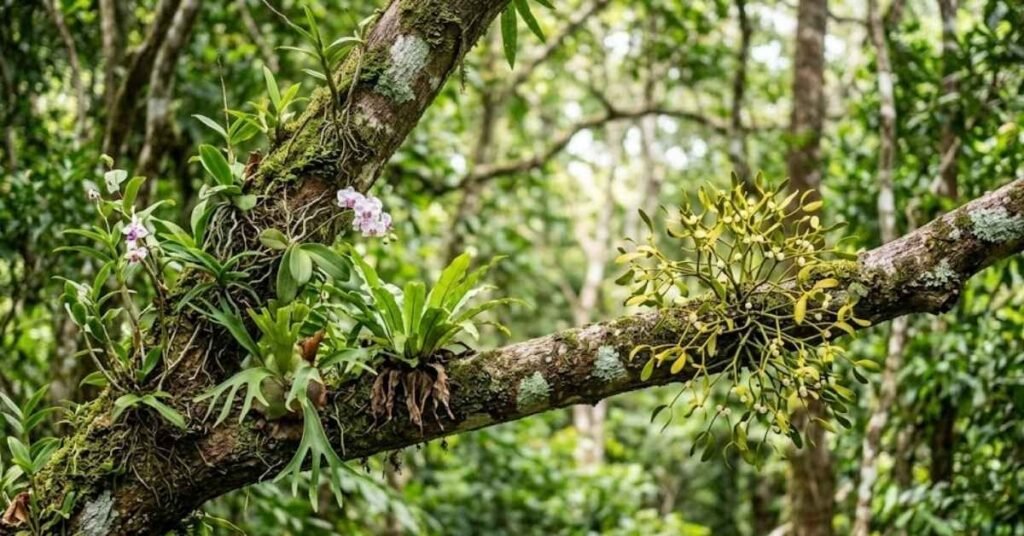
These plants spend their entire life cycle off the ground. They never touch soil.
Examples: Most orchids, Tillandsia (air plants), many bromeliads
2. Hemi-Epiphytes
These start life on a tree but eventually send roots down to the ground or they start in soil and climb upward.
Examples: Monstera deliciosa, Philodendron, Strangler fig
10 Most Popular Epiphytic Plants to Grow at Home
| Plant | Type | Care Level | Best For |
| Tillandsia (Air Plant) | Holo-epiphyte | Easy | Beginners |
| Phalaenopsis Orchid | Holo-epiphyte | Easy–Medium | Flowers |
| Staghorn Fern | Holo-epiphyte | Medium | Wall display |
| Bird’s Nest Fern | Holo-epiphyte | Easy | Low light rooms |
| Bromeliad (Neoregelia) | Holo-epiphyte | Easy | Color + drama |
| Monstera deliciosa | Hemi-epiphyte | Easy | Large spaces |
| Hoya (Wax Plant) | Hemi-epiphyte | Easy | Trailing vines |
| Rhipsalis (Jungle Cactus) | Holo-epiphyte | Easy | Hanging baskets |
| Peperomia | Holo-epiphyte | Easy | Small spaces |
| Dendrobium Orchid | Holo-epiphyte | Medium | Mounted displays |
How to Care for Epiphytic Plants: Step-by-Step
Step 1 — Choose the Right Growing Medium
Epiphytes hate regular potting soil. It holds too much moisture and will rot their roots.
Better options:
- Orchid bark (great airflow)
- Sphagnum moss (holds moisture but breathable)
- Coconut coir
- A mix of bark + perlite + moss
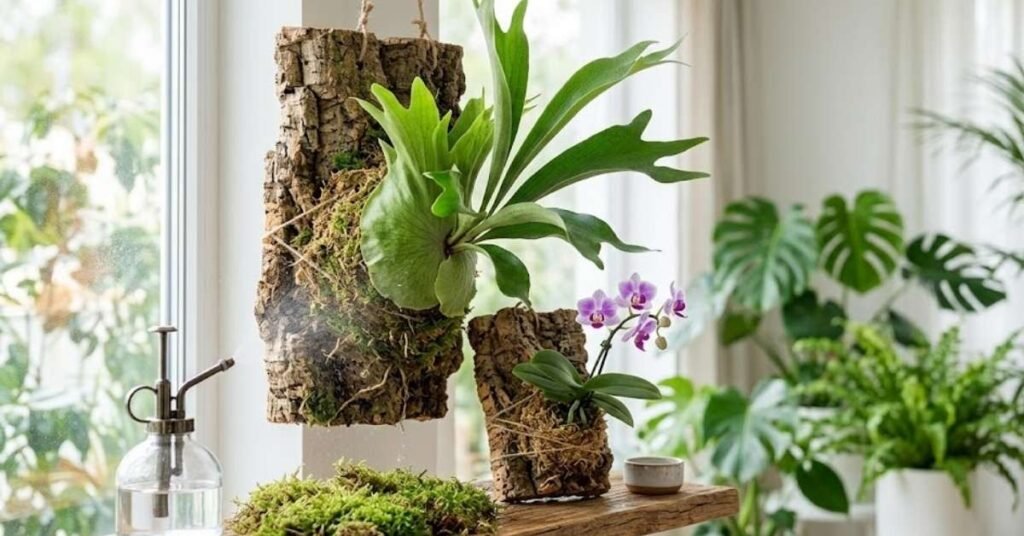
For Tillandsia, skip the soil entirely. Mount them on cork, driftwood, or just display them freely.
Step 2 — Get the Watering Right
This is where most beginners go wrong. Epiphytes absorb water through their leaves and aerial roots — not from sitting in wet soil.
General watering rules:
- Water less than you think you need to
- Allow roots to dry out slightly between waterings
- Mist the air around them for humidity don’t drench the medium
- For Tillandsia: soak in water for 20–30 minutes once a week, then let dry upside down
Step 3 — Provide the Right Light
Most epiphytes evolved under forest canopies; they get bright, filtered light, not direct sun.
- Best windows: East-facing or north-facing
- Avoid: Direct midday sun (it burns the leaves)
- Low light options: Bird’s Nest Fern, Peperomia, Rhipsalis
Step 4 — Humidity Is Everything
These plants come from humid rainforests. Aim for 50–70% relative humidity if possible.
How to boost humidity at home:
- Place a tray of pebbles filled with water under the pot
- Group plants together (they create a microclimate)
- Use a small humidifier nearby
- Keep them in the bathroom (steam from showers helps!)
Step 5 — Feed Lightly
Epiphytes don’t need much fertilizer; they’re adapted to low-nutrient environments.
- Use a diluted, balanced liquid fertilizer (e.g., 20-20-20 at quarter strength)
- Feed once a month during spring and summer
- Skip fertilizing in fall and winter
Mounting Epiphytes: The Science Behind It (Not Just Aesthetics)
One of the most rewarding ways to grow epiphytes is to mount them, just like they grow in the wild. But your choice of mounting material isn’t just decorative; it directly affects how long the mount lasts, how well roots attach, and whether your plant thrives or declines. Here’s the physics behind it.
Why Wood Choice Matters
Cork bark is the gold standard for mounting. Its natural surface is rough and porous, which gives roots microscopic grooves to grip. It’s also highly rot-resistant ]cork is essentially waterproof bark so it doesn’t break down even after years of regular soaking. Expect a cork mount to last 5–10+ years.
Cedar is the second-best choice. Cedar contains natural oils (thujaplicin) that actively resist fungal rot and insect damage. Unlike pine, it won’t become soft and spongy after repeated watering cycles. The fibrous grain also gives roots something to anchor into.
Pine and cheap softwoods are a common mistake. They look fine at first, but soften and decay within 12–18 months of regular moisture exposure. As the wood breaks down, it can harbor fungal pathogens that infect the plant’s roots.
Driftwood is beautiful but variable. Marine driftwood that’s been naturally weathered is very dense and rot-resistant. Freshwater driftwood is softer and breaks down faster. Always soak driftwood for 48 hours to leach out any residual salts before mounting.
Tree fern fiber boards (often sold as “totem boards”) mimic the texture of natural tree bark better than any wood roots penetrate directly into the fibrous matrix and anchor in weeks. The drawback is cost and availability.
Weight and Physics: Don’t Let Your Mount Fail
Staghorn ferns can grow to 50+ lbs (23 kg) at maturity. A poorly mounted plant that falls damages both the plant and whatever is below it.
Rules for heavy mounts:
- Use at minimum a 3-inch wood screw or heavy-duty wall anchor rated for 3× the plant’s expected mature weight
- Mount on a stud when possible drywall anchors alone can fail under prolonged moisture exposure
- For very large specimens, use two mounting points spaced at least 6 inches apart
How to Mount Step-by-Step
- Select your mount material (cork or cedar recommended)
- Soak the mount in water for 30 minutes to pre-hydrate it
- Wrap the plant’s roots in a golf-ball-sized clump of moist sphagnum moss this acts as a moisture reservoir
- Position the plant on the mount and hold in place with one hand
- Tie securely using monofilament fishing line (invisible) or natural jute twine (biodegrades in 1–2 years, by which time the roots self-anchor)
- Do NOT use copper wire it’s toxic to many epiphyte roots
- Hang in a spot with good air circulation and indirect light
- Mist or soak regularly until you see new root growth attaching to the mount (usually 4–8 weeks)
Seasonal Care Guide
| Season | What to Do |
| Spring | Resume regular watering; begin monthly fertilizing; repot if roots are crowded |
| Summer | Water more frequently; watch for pests; increase humidity |
| Fall | Reduce feeding; cut back watering slightly as growth slows |
| Winter | Minimal water; no fertilizer; move away from cold drafts and heating vents |
Common Beginner Mistakes (And How to Avoid Them)
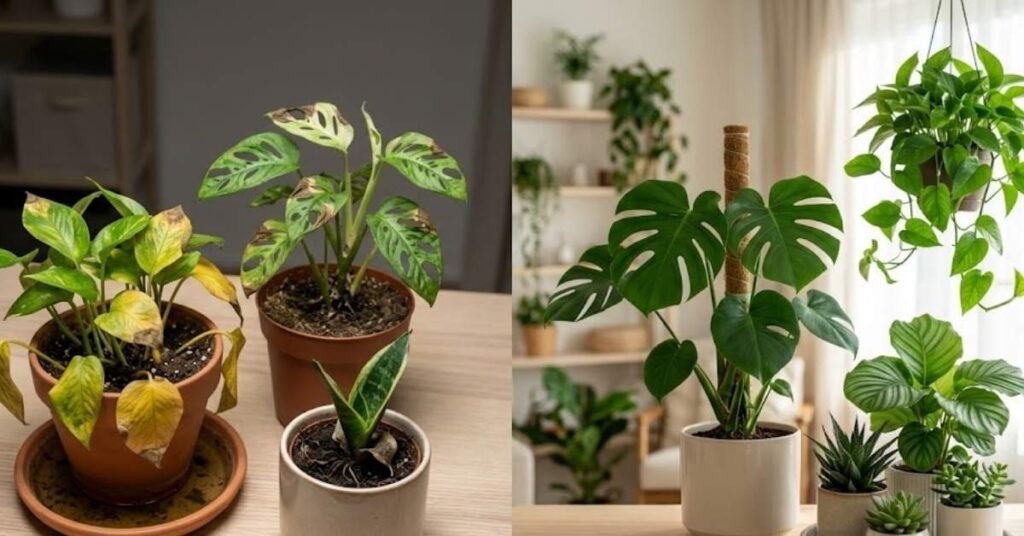
1. Overwatering — The #1 killer. Wet roots = root rot. When in doubt, wait another day.
2. Using regular potting soil — Too dense for epiphyte roots. Always use bark, moss, or a specialized mix.
3. Placing in direct sun — Most epiphytes get filtered light in the wild. Direct afternoon sun scorches their leaves.
4. Ignoring humidity — Dry indoor air causes brown leaf tips and slow growth. Boost humidity, especially in winter.
5. Over-fertilizing — More fertilizer does NOT mean faster growth. It burns the roots. Stick to quarter-strength once a month.
6. Misting the plant directly — Misting leaves can cause fungal spots. Mist the air around the plant instead.
7. Keeping them too cold — Most tropical epiphytes suffer below 55°F (13°C). Keep them away from cold windowsills in winter.
Pest & Disease Troubleshooting Guide
| Problem | Cause | Solution |
| Root rot | Overwatering or dense soil | Remove plant, trim rotted roots, repot in dry bark |
| Brown leaf tips | Low humidity or dry air | Increase humidity; move away from vents |
| Yellow leaves | Overwatering or low light | Reduce watering; move to brighter spot |
| White cotton patches | Mealybugs | Wipe with alcohol-soaked cotton swab; spray neem oil |
| Tiny sticky insects | Aphids or scale | Spray with diluted dish soap solution |
| Mushy stems | Fungal rot | Improve airflow; reduce misting; remove affected areas |
Indoor vs. Outdoor Growing
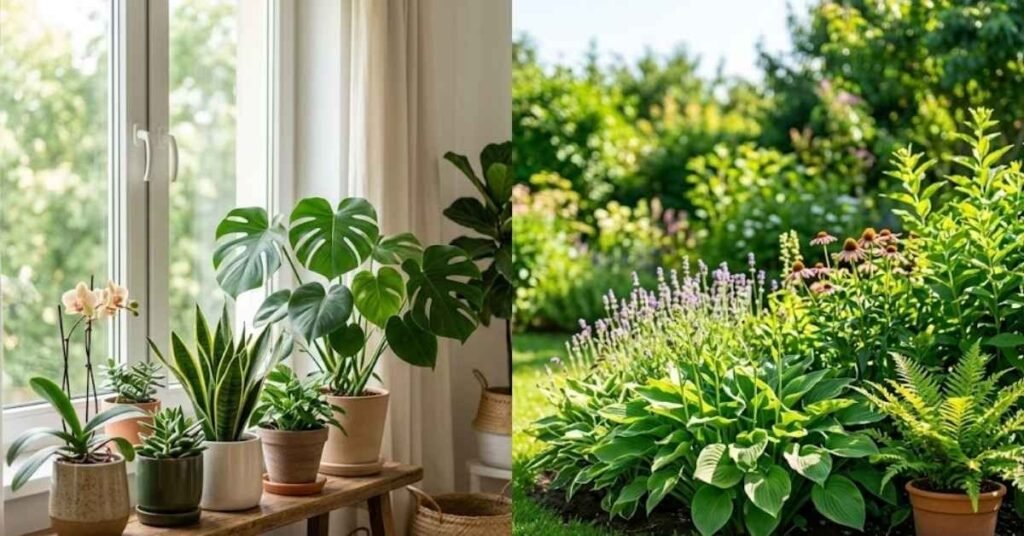
Growing Epiphytes Indoors
- Best for: Orchids, Tillandsia, Hoyas, Peperomia, Rhipsalis
- Keep away from: AC vents, radiators, cold drafts
- Ideal spots: Bathrooms, kitchens, bright living rooms
Growing Epiphytes Outdoors
- Best for: Staghorn ferns, Bromeliads (in warm climates), orchids in summer
- Best climates: USDA zones 9–12 year-round; zones 5–8 in summer only
- Watch for: Frost damage (bring inside below 50°F/10°C)
- Mounting outdoors on trees creates a stunning, natural display
Toxicity Information
Some epiphytes can be toxic to pets and children. Here’s what to know:
| Plant | Toxic to Cats/Dogs? | Toxic to Humans? |
| Tillandsia (Air Plant) | No — pet safe | No |
| Bromeliad | No — generally safe | No |
| Phalaenopsis Orchid | No — non-toxic | No |
| Monstera deliciosa | Yes — causes irritation | Mildly (raw plant) |
| Hoya | Mildly toxic | Mild irritant |
| Rhipsalis | Generally safe | No |
Always check the ASPCA toxic plant list before buying if you have pets.
Pro Tips From Experienced Growers
Tip 1: The best place for epiphytes in your home? The shower. Steam, indirect light, and warmth it’s basically a rainforest.
Tip 2: Never use tap water with high chlorine or fluoride for air plants. Use filtered water or rainwater for best results.
Tip 3: Don’t throw away a mounted plant that looks dead. Soak the whole mount in water for an hour and many “dead” epiphytes bounce back.
Tip 4: Group epiphytes with other humidity-loving plants. They’ll create a shared microclimate that benefits the whole group.
Tip 5: Cork bark mounts last for years and look incredible on a wall. Use multiple species on one large piece for a living art display.
Quick Care Summary Table
| Factor | Most Epiphytes Need |
| Light | Bright, indirect |
| Water | Let dry between waterings |
| Humidity | 50–70% |
| Temperature | 60–85°F (15–29°C) |
| Soil/Medium | Orchid bark, moss, or mounted |
| Fertilizer | Quarter-strength, monthly (spring–summer) |
| Repotting | Every 2–3 years or when roots overflow |
FAQ: Plants Growing on Other Plants
Q1: Are plants that grow on other plants harmful to trees? No. True epiphytes don’t take anything from the host plant. They simply use the tree as a surface to sit on. Parasitic plants (like mistletoe) are different; they do draw nutrients from the host.
Q2: Can I attach an epiphyte to my garden tree? Yes! Orchids, bromeliads, and staghorn ferns can be mounted directly onto tree bark outdoors in warm climates. Use moss to cushion the roots and tie with soft twine until the plant anchors itself.
Q3: Why do my air plant’s leaves keep turning brown at the tips? Usually low humidity or underwatering. Try soaking your Tillandsia for 30 minutes once a week instead of misting, and move it to a more humid spot.
Q4: Do epiphytes need soil at all? True holo-epiphytes like Tillandsia need zero soil. Others, like orchids and hoyas, grow better in a very loose, bark-based mix that gives roots airflow while holding a little moisture.
Q5: What’s the easiest epiphyte for a complete beginner? Tillandsia (air plants) or Phalaenopsis orchids. Air plants are nearly indestructible with weekly soaking. Moth orchids (Phalaenopsis) bloom for months and forgive irregular watering.
Q6: How fast do epiphytes grow? Slowly, in most cases. Orchids may produce a new leaf every 4–6 weeks. Staghorn ferns grow faster in high humidity. Don’t expect rapid growth — their slow pace is part of their charm.
Q7: Can I grow epiphytes without a greenhouse? Absolutely. Most popular epiphytes — hoyas, orchids, air plants, peperomia thrive on windowsills and in bathrooms. A simple humidity tray and indirect light is all you need.
Conclusion
Epiphytes are unlike any other group of houseplants. They grow without soil, cling to trees in the wild, and thrive on nothing but air, rain, and a little help from you.
Whether you start with a single Tillandsia on your desk or mount a staghorn fern on a piece of driftwood, you’re bringing a piece of the rainforest into your home.
Ready to start? Pick up an easy-care air plant or Phalaenopsis orchid from your local nursery or shop online at a specialty epiphyte retailer. Once you grow one successfully, you’ll want a dozen more.
Recommended Products (Affiliate-style suggestions)
- Orchid bark mix — The ideal base medium for most potted epiphytes. Look for a blend with fine bark, perlite, and charcoal.
- Cork bark sheets or rounds — Perfect for mounting air plants and ferns. Durable, natural, and looks beautiful on walls.
- Small ultrasonic humidifier — A simple way to maintain 60%+ humidity around your epiphyte collection year-round.
Have questions about your epiphytes? Drop them in the comments — we love hearing from fellow plant lovers!

Amin Khalid is a professional horticulturist and the founder of LeafyWisdom. With a deep passion for home gardening and horticultural research, he specializes in providing practical, easy-to-follow care guides for indoor plants. Amin’s goal is to simplify gardening for everyone and help fellow plant lovers build their own thriving green spaces.